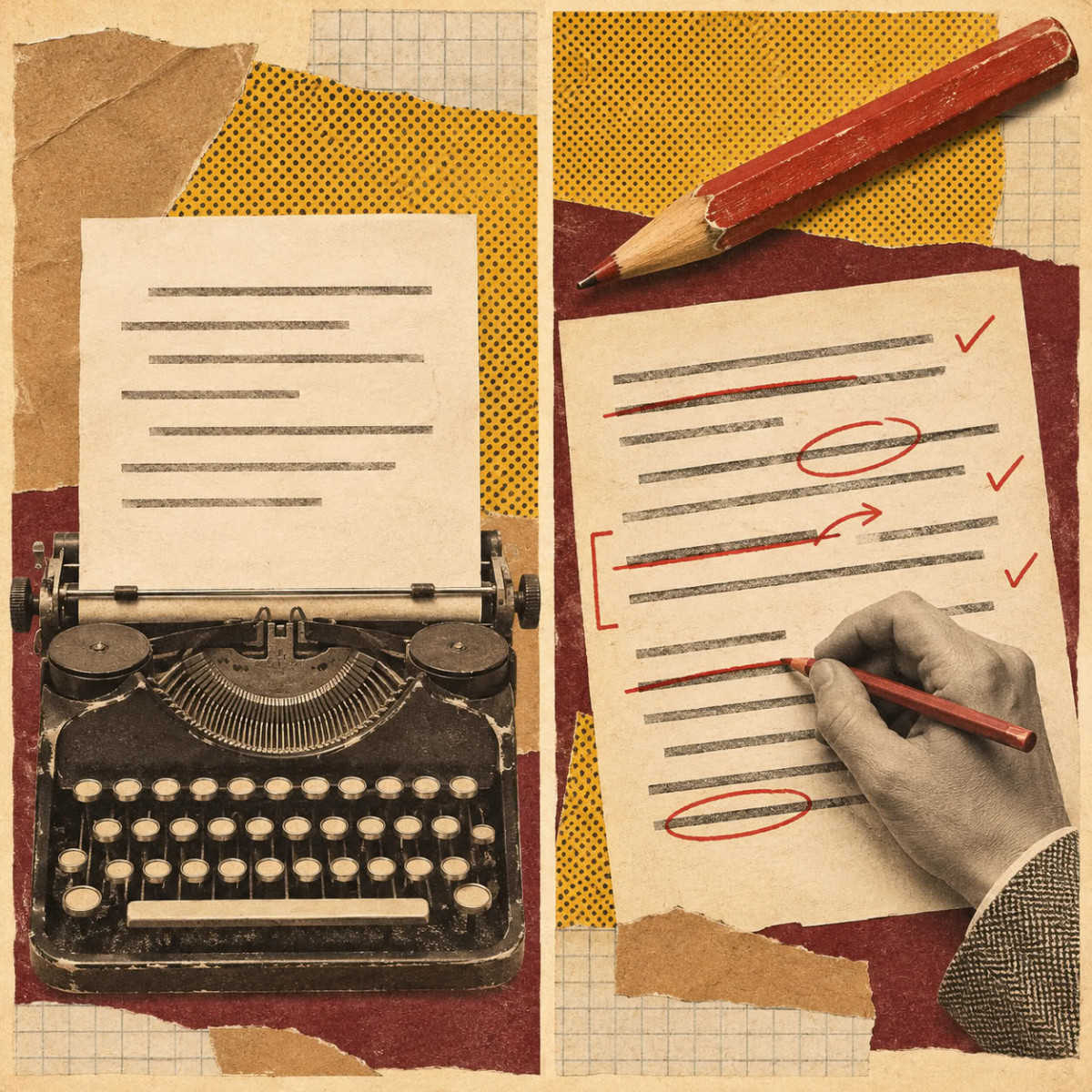

Generative AI has shifted the writing effort to proofreading, a step almost no one learns. A three-pass method is proposed, along with a precise role for managers: designate what never goes out without human review.
- Generative AI shifts the work from writing to proofreading, a skill few people learn.
- AI texts sound fluent and confident, so their errors are easy to miss.
- Proofread in three passes : check facts, test the reasoning, then check the recipient.
- Managers should list what never leaves the company without human review.
In most generative AI training, the first hour covers how to formulate a request: role, context, expected format, examples. This step is useful, but the other half of the work is costly when missed, and that’s proofreading.
Before AI, writing a note took an hour and proofreading it a few minutes. Today, the first draft arrives in thirty seconds, and everything hinges on what happens next. Yet few people have learned to proofread a text they didn’t write and that seems correct.
A text that seems correct
A text produced by a language model, i.e., a program trained to produce text, is fluent, well-structured, and confident. Its errors don’t look like a spelling mistake. They hide in a plausible figure, a date off by a year, a non-existent product name, or a rule that no one ever wrote.
The style reassures precisely where one should be wary. According to the author, highly competent teams have let slip errors they would never have made themselves, the form giving them no reason to slow down.
Proofreading in three passes
The first pass focuses on facts: figures, names, dates, quotes, and references are checked against the source. What cannot be verified is removed or rephrased. This is the most tedious pass, and the only one that avoids truly costly errors.
The second focuses on reasoning. Does the conclusion follow from what precedes it? Models know how to string together sentences that resemble an argument, and asking “why?” for each paragraph often helps spot where the reasoning slips.
The third focuses on the recipient: does the text say what we mean, to that person, with the right tone? A flawless email can be too long for a busy client or too cold for a colleague. Once the habit is formed, these three passes take only a few minutes.
The manager’s role
The manager doesn’t need to be an AI expert to play a decisive role. They simply need to make explicit what everyone currently decides alone: a short, written list, known to the whole team, specifying what goes out to a client, what commits the company, and what concerns a person, an evaluation, or a conflict. Without this list, everyone sets their own rule, and the most common one is to have none.
This clarity also strengthens trust. A team that knows where the guardrails are dares to use the tool more.
According to the Insee, more than half of companies using AI say they are held back by a lack of expertise: 53% in 2025. For the author, this expertise is less about technology than about the job. Knowing what to check and what to refuse to send concerns the accountant, the lawyer, or the salesperson as much as the IT department.
The promised time savings don’t withstand sloppy proofreading, and an email sent with an error always costs more to fix than the time saved writing it. Writing a good request is learned in an afternoon, whereas proofreading with discernment takes more time.
