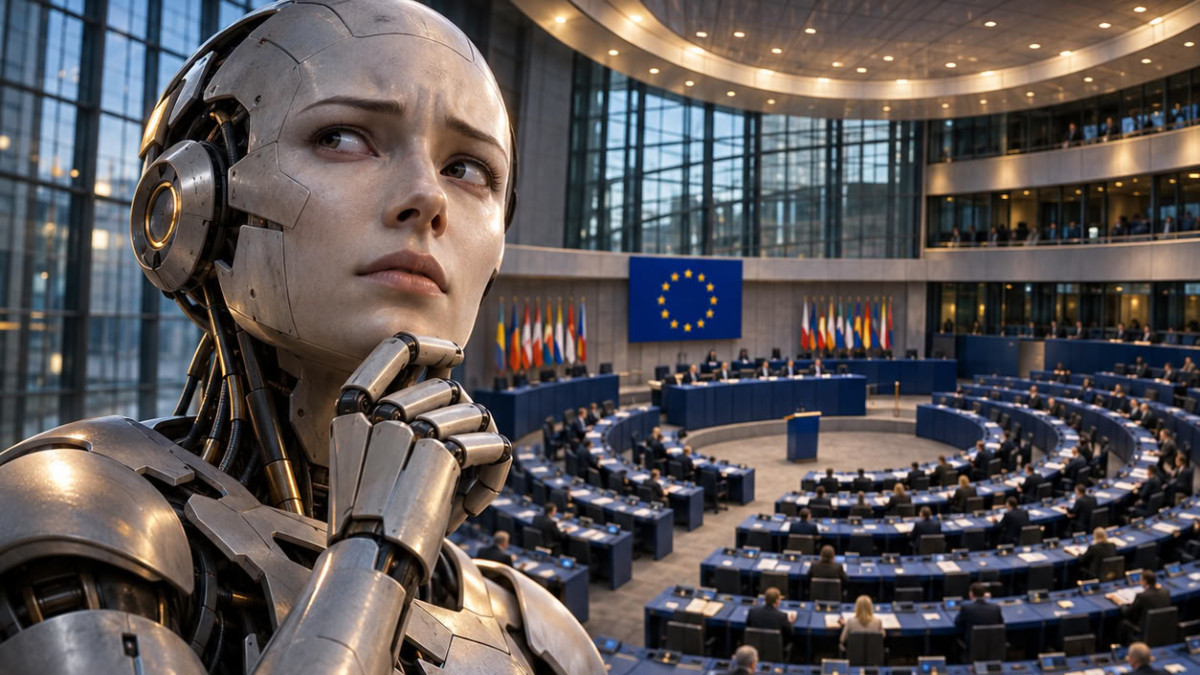

The European Parliament is preparing new recommendations on the use of artificial intelligence by its members, as amendments drafted with the help of these tools multiply. Its President, Roberta Metsola, has warned MEPs against excessive reliance on AI in their legislative work.
- The European Parliament prepares recommendations on how its members use artificial intelligence.
- President Roberta Metsola warns that AI cannot replace political debate or the judgment of elected officials.
- Some amendments already cite non-existent legal texts, because AI tools can produce confident but false answers.
- The Parliament urges members to be transparent, never share sensitive documents with public tools, and verify all AI-generated content.
During an event dedicated to AI within the institution, the President reminded that these tools cannot replace either political exchanges or the judgment of elected officials. “Drafting an amendment with the help of AI fundamentally cannot replace a constructive exchange with a colleague,” she said.
This warning also applies to legal research. The answers provided by AI models do not exempt elected officials from exercising discernment and critical thinking, especially in the face of complex decisions. Roberta Metsola also insists on democratic accountability: citizens must be informed about the use of AI in the legislative process and be able to clearly identify the elected officials responsible for the decisions taken.
Risks already visible
Some amendments reportedly contain references to non-existent legal texts, illustrating the errors and hallucinations (false answers presented confidently) that generative tools can lead to. Alessandro Chiocchetti, Secretary General of the Parliament, reported the case of an MEP who asked an AI for erroneous legal advice. The institution’s lawyers then reportedly spent two days demonstrating that the answer provided by ChatGPT was false.
The Parliament is preparing new recommendations for its members, which are to be presented soon to the institution’s governing bodies. MEPs are currently not required to declare their use of AI, and making these recommendations binding would require amending the Parliament’s Rules of Procedure. The rules applicable to staff, dating from 2024, are also under review.
The Secretary General summarized the envisaged principles in three rules: be transparent about the use of artificial intelligence, never transmit sensitive documents to public tools, and systematically verify generated content before dissemination. An essential precaution, as elected officials and their teams handle confidential information and legislative working documents. In parallel, the Parliament is developing its own AI tool, hosted on its internal infrastructure, to handle the most sensitive work. According to POLITICO, which reported it in July, commercial models like ChatGPT, Claude or Llama remain usable for less confidential tasks.
AI as an assistance tool
The European Parliament does not, however, intend to forgo the possibilities offered by AI. Alessandro Chiocchetti notably highlights the usefulness of these technologies for analyzing and classifying the thousands of amendments submitted for MEPs’ consideration. AI could thus facilitate certain documentary tasks, speed up preparatory work, and lighten the workload of teams. The Secretary General specifies, however, that the drafting and examination of laws must remain the work of elected officials.
