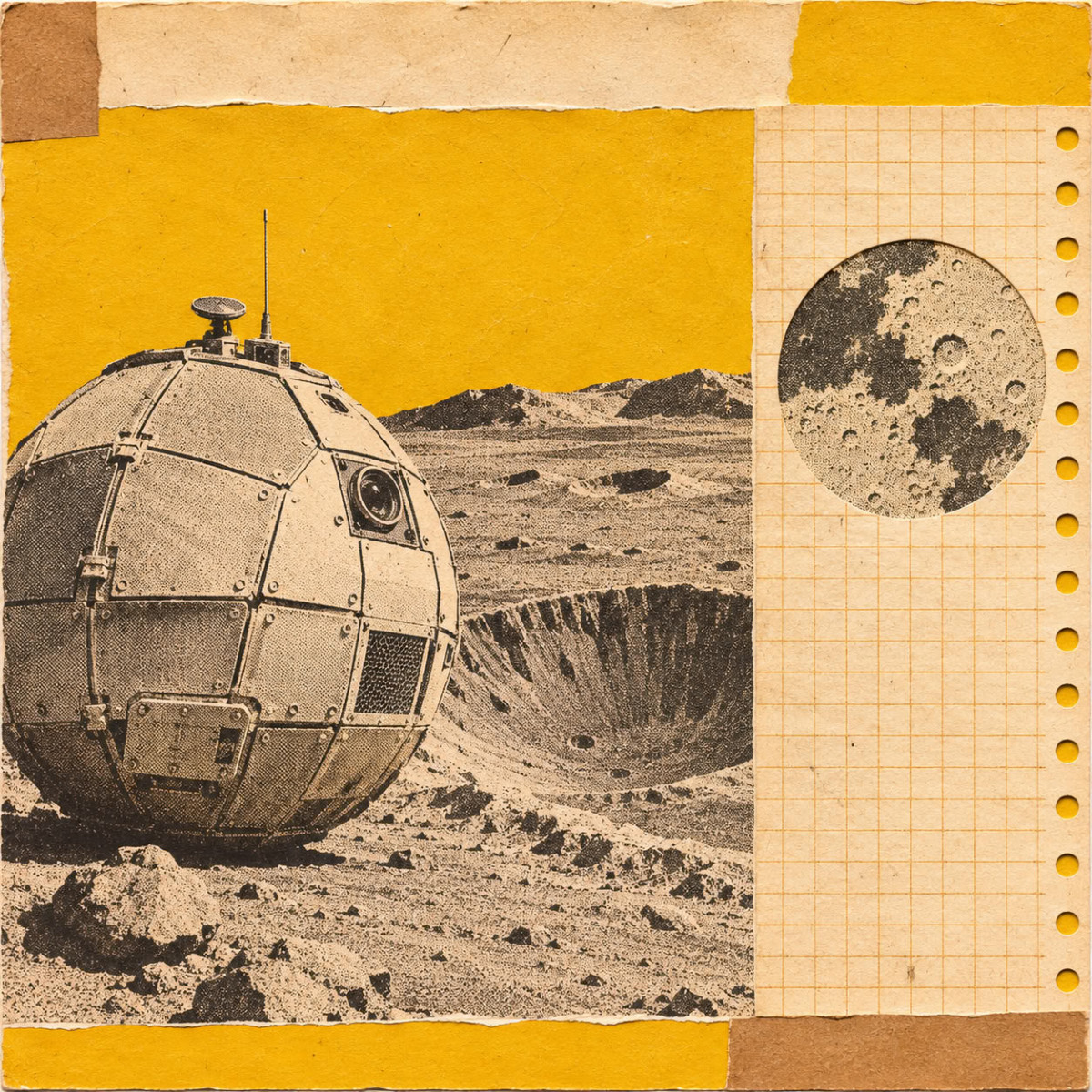

In a quarry in central Texas, an inflatable spherical robot named RoboBall rolls over rocks, gravel, and wet clay. Developed at Texas A&M University in College Station, it is intended to explore lunar terrains that are currently difficult to access. The results of its initial tests are detailed in a recent article published in IEEE Transactions on Field Robotics.
The project is led by Rishi Jangale, a mechanical engineer nearing the end of his doctorate, and his colleagues in the lab, who have been working on this “big beige ball” for about five years. The goal is to have a vehicle capable of reaching areas like the Shackleton crater, which is 21 km wide and located at the Moon’s South Pole. According to the source, this crater is 4 km deep and contains smaller, even deeper craters, parts of which never receive sunlight.
These dark zones contain substances that planetary scientists struggle to study, including layers of very ancient lunar geology and reserves of frozen water, which could one day serve a lunar base. “The Moon is like an archive of what happened on Earth, ” says Sara Russell, a cosmic mineralogist at London’s Natural History Museum, who is not involved in the Texas A&M work. She adds: “Robotic collection works remarkably well, and it’s great to see it being explored more in this context.”
For Rishi Jangale, the choice of a sphere addresses a specific constraint. “NASA won’t let astronauts approach these craters, because if someone falls in, you won’t be able to get them out, ” he says. “So we thought: what shape is better suited to roll down a slope than a ball?”
An idea born in 2003
RoboBall originated from an idea by Robert Ambrose, a former NASA robotics engineer and Jangale’s thesis advisor, who conceived the principle as early as 2003. According to the source, an inflatable sphere cannot tip over, a major risk for robots on the lunar surface, especially in low gravity. Its shape also protects its internal components from sharp rocks, dust, and temperature swings, which, according to the article, range from over 93 °C in sunlit areas to minus 240 °C in the shadows of craters.
The scenario envisioned by Ambrose involves a wheeled rover, which parks at the edge of a crater and releases a RoboBall to explore its depths. Unlike a small rover tethered by a cable, the sphere does not climb back up on its own, but it can travel a much greater distance to collect geological samples, then send them back to the rover using small rockets. NASA has not returned lunar samples to Earth in over 50 years, according to the source, and lunar meteorites do not replace, according to Sara Russell, the fieldwork done on site.
From prototype to full version
In 2022, Ambrose’s lab completed a proof of concept, RoboBall II, which is 0.5 meters wide. The full-scale version, RoboBall III, then took about eleven months of work. “We were building these robots very quickly, ” says Jangale, citing encouragement from his advisor: “He pushes us to use these robots and break them.” Initial tests revealed software errors and a transmission too weak to overcome small bumps on soft ground.
RoboBall moves thanks to a pendulum placed inside its shell, which shifts the overall center of mass. On flat terrain, when the pendulum arm points forward, the sphere rolls in that direction. A slight tilt to the left or right makes it turn in the same direction. “The robot wants to go where you point the pendulum, ” explains Jangale. On steep slopes, the same mechanism allows control of the descent speed.
Hiro Ono, an aerospace engineer who worked for thirteen years on robot mobility at NASA’s Jet Propulsion Laboratory before joining Georgia Tech, highlights the simplicity of the device: “The beauty is in the simplicity.” RoboBall has only two actuators, both placed inside the shell, protected from dust.
After the initial quarry tests, the team designed an improved version, RoboBall III, in about seven months, featuring torque-rotational force-multiplied by 2.5. It can thus overcome small obstacles and climb slopes of 20 degrees. In the new article, the remotely piloted RoboBall III descended the quarry slopes, crossed loose terrain, and launched hypothetical payloads out of the crater.
A mission still far off
The robot would not be suitable for all missions, the team acknowledges: its somewhat clumsy nature makes it poorly suited for picking up a very specific rock. The researchers hope to work with scientists designing instruments for the Moon, so that they fit inside the sphere, which is the size of a carry-on bag. “The robot is not the mission, ” concludes Jangale. “The robot is a means to accomplish the mission.”
The current version cost about $250,000 and is not ready for the Moon. While its gold-anodized aluminum parts are suitable for space missions, its other materials are not, and space-rated electronics would cost more. The shell, capable of rolling over steel shards and withstanding minus 184 °C, has never been tested under extreme lunar conditions. The team also plans to make the sphere capable of autonomously adapting its driving on varying slopes.
Texas A&M is set to open later this year, in Houston, a new facility housing, according to the source, the world’s largest indoor simulated lunar and Martian landscapes. It is located 190 km from the quarry where Rishi Jangale conducts his tests.
