
IEEE Spectrum’s weekly robotics video selection highlights a robot that moves water inside its body to traverse slopes and steps, as well as a quadruped designed to operate underwater. It also features a robotic optics lab from MIT and the commissioning of a humanoid robot factory announced by UBTECH.
Shifting Its Weight to Move Forward
The robot named WorMa, developed by researchers at the NYU Tandon School of Engineering, alters its weight distribution by circulating water between its head and tail. On a slope, the configuration where water is placed towards the head was the only one that allowed WorMa to climb the steepest slope tested, at 19.5 degrees, with other configurations causing it to slide down. This distribution also reduced its cost of transport by at least 33% compared to other configurations.
Steps required a different method. Neither a head-heavy nor a tail-heavy robot could clear a step on its own. The researchers therefore had WorMa approach with water in the head, then moved the water to the tail, raising the head and neck so the tail could push the robot closer to the step. Once the head was placed on the edge, the water returned to the head and the robot continued its progress. This sequence allowed it to clear steps up to 15 centimeters high.
The selection’s captions also mention a quadruped designed for water. According to the authors, legged robots are versatile on land but remain underutilized underwater. The featured robot relies on waterproof motor housings machined from polyoxymethylene, a plastic, equipped with commercial O-rings and dynamic shaft seals. A simplified model describes the system’s dynamics, and a closed-loop attitude controller was evaluated in simulation and in a tank, where the robot follows roll, pitch, and yaw orientation commands.
Lab, Factory, and Telepresence
At MIT, engineers have built a robotic optics lab capable of assembling, operating, and then disassembling an experiment on demand. A robotic arm handles mirrors and lenses, each housed in a QR-coded enclosure, to steer and focus a red laser beam. This autonomous system could accelerate testing of high-tech materials, from solar cells to displays and quantum technologies. The video is sped up two times.
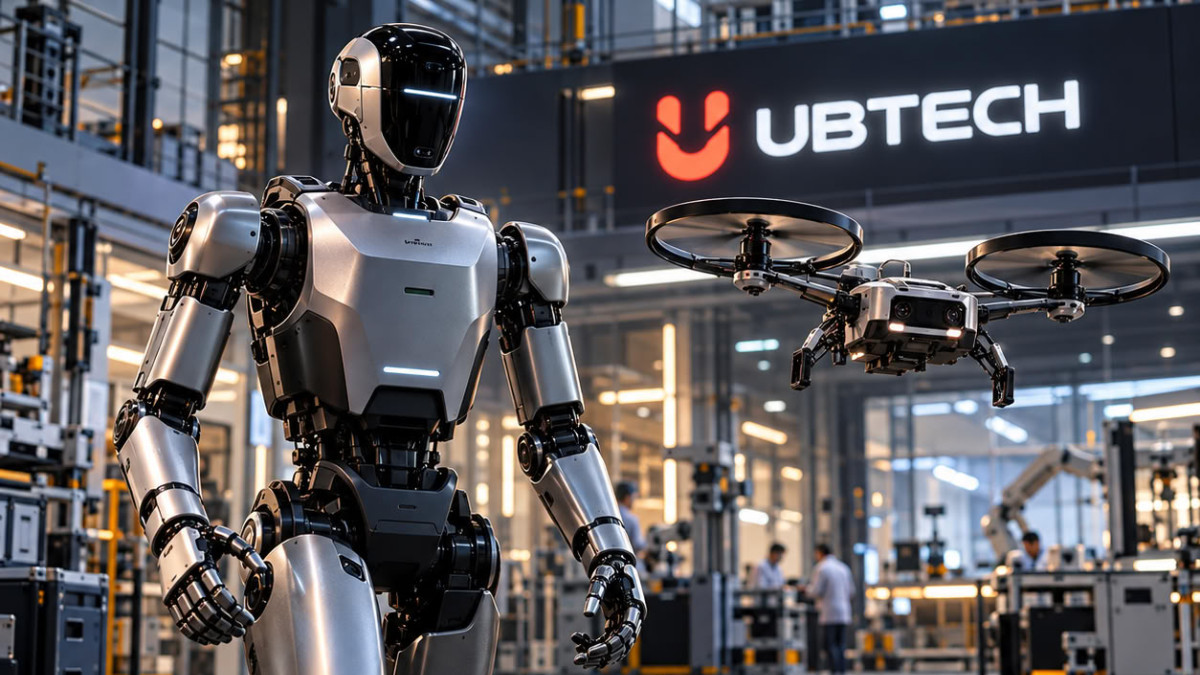
UBTECH, for its part, announces the commissioning of its flagship humanoid robot factory. According to the company, a humanoid robot comes off the line every 10 minutes, and it states it has passed the milestone “from 1,000 to 10,000 units in less than 9 months”.
Finally, the Kubi 2.0 robot is presented as a desktop telepresence robot, allowing remote users to look around and interact as if they were on site. The manufacturer also describes it as a physical AI device, capable of enabling AI agents to interact with people in their environment. According to the same source, the company has been operating its telepresence solutions in Japan for over a decade to help hospitalized or homebound students attend their classes, and is now expanding this initiative globally via Kickstarter.