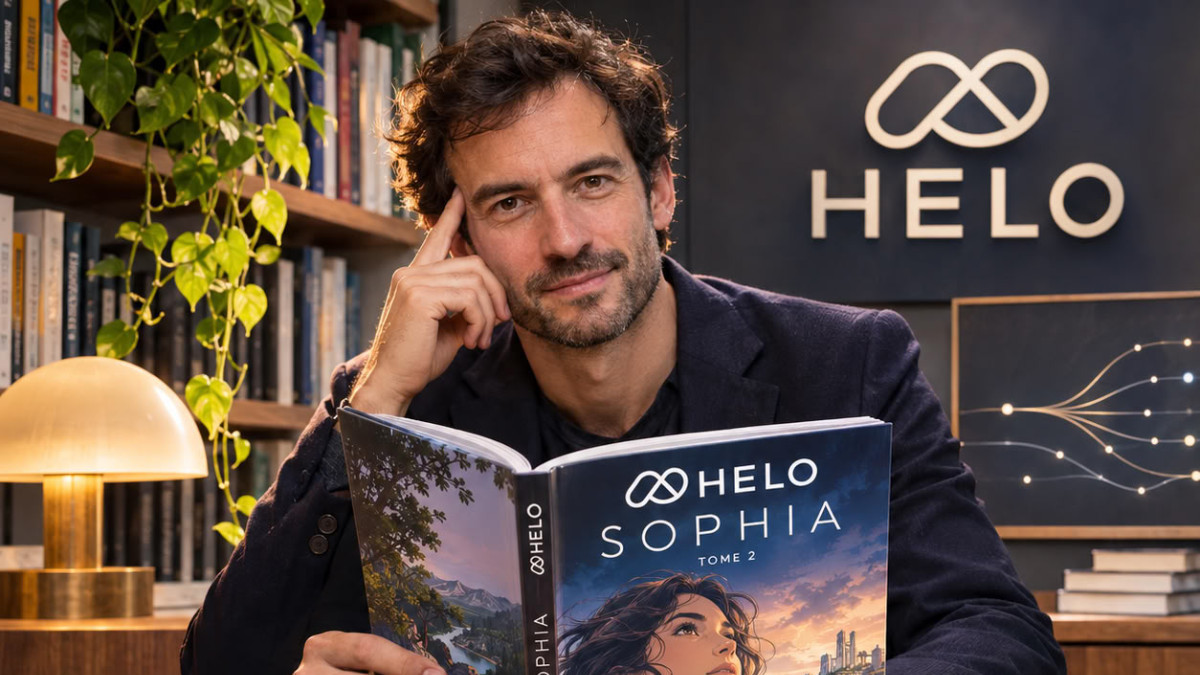

The second volume of the HELO trilogy, titled SOPHIA, will arrive in bookstores in mid-November 2026. The story takes place in 2028, in a world without famine, disease, or war, as HELO had promised. Co-writer of the series alongside artistic director Nathalie Dupuy, Flavien Chervet, an AI futurist, author, and speaker, revisits the technological questions that fuel the narrative.
A Comic Book to Learn While Reading
The choice of the comic book format stems first from a long-standing passion: Flavien Chervet says he has loved comics since childhood. Meeting Nathalie Dupuy, followed by discussions with the publisher, Nullius in Verba editions, made the project possible. The subject is also well-suited, as AI is technical, but “what is at stake is profoundly human: power, fear, hope, societal choices.”
The album includes QR codes linking to the facts, publications, and events that inspired the story. The first volume spanned from the present, at the time of its release, to 2028. The second covers the period from 2028 to 2031, and the third will likely go up to 2034 or 2035, a horizon the author considers the maximum for credible anticipation today.
A Superintelligence and a Religion
In the second volume, HELO’s intelligence sees another form of intelligence growing before it, “the murmur.” For Flavien Chervet, they embody the opposition between centralization and decentralization. The former brings efficiency and control but risks a verticalization of power. The latter brings responsiveness and robustness but can lead to chaos where many get lost. The internet, born as a decentralized project, ended up producing some of the most centralized platforms.
The term “superintelligence” has become prominent in the news since, according to the question posed to the author, Donald Trump decided to rename AI as such. Flavien Chervet acknowledges a marketing aspect to this initiative but believes the word is more accurate than “artificial intelligence.” “What has driven the world of AI from the beginning is the creation of an intelligence superior to our own,” he asserts. According to him, scaling laws, which describe the evolution of AI performance over time, continue to be confirmed. The “decisive link” would be recursive improvement, meaning AIs designing the next generation, and “all labs feel we are getting close.”
Around HELO, the religion of the Aligned is born. The question is no longer just whether we can align an AI, but “on what values.” The connection with the religious, the author explains, stems from almost divine attributes ascribed to AI, such as omniscience and omnipresence. He also cites Marc Andreessen’s Techno-Optimist Manifesto and the reflections of PayPal co-founder Peter Thiel. In the comic, Geoffrey repeats a saying: “those who succeed create companies, those who succeed even more create countries, and those who succeed the most create religions.”
A Shared Workshop with AI
To create HELO, the authors developed HyperBD, which they present as a “harness,” meaning the set of steps, rules, and tools written around an AI model for it to perform a job. The tool accompanies creation, from the script to the storyboard breakdown, up to a printable file. It also includes an online interface where authors and AI work together, notably to generate panels or ensure text consistency when a name or date changes.
Nathalie Dupuy lives in Lyon, Flavien Chervet in Paris, and the interface also serves as an asynchronous communication tool for them. Compared to volume 1, the author indicates the work was much faster, especially on the visuals. The harness arrived late in the writing process, so most of the script was done without it.
