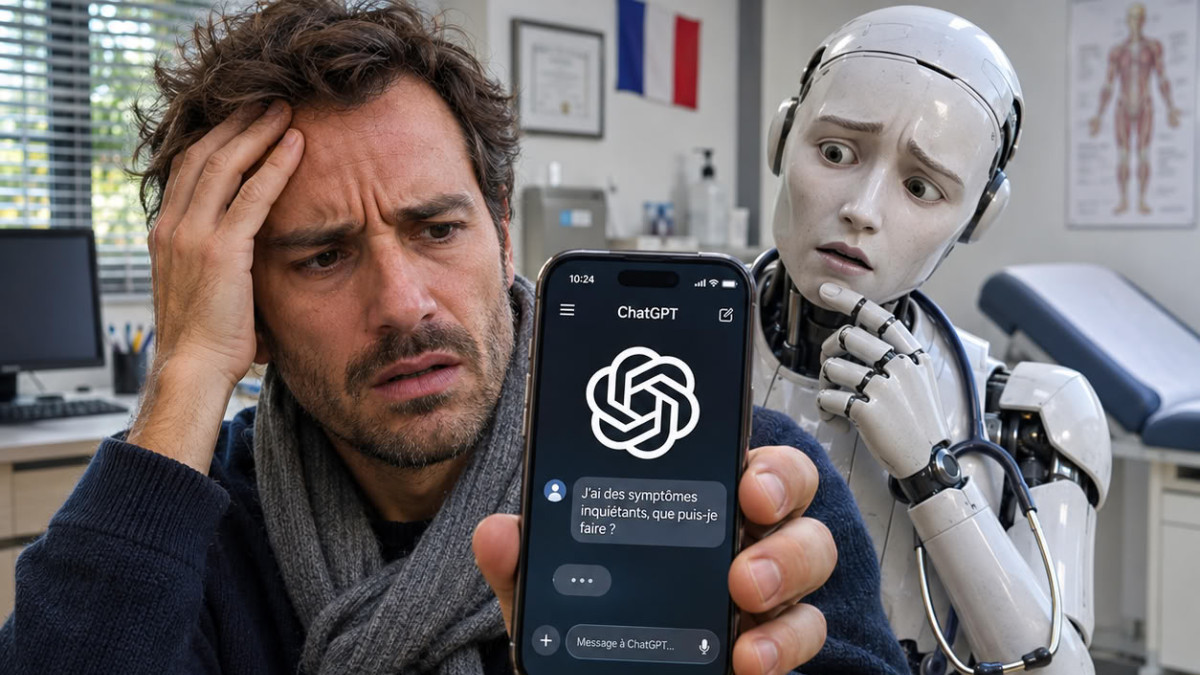

Many French people seek medical advice from an artificial intelligence before consulting a doctor. According to Dr. Pierre De Brémond, a general practitioner, this widespread practice is not without risk.
- Many French people consult AI before seeing a doctor.
- One in two French people uses AI for health questions.
- AI cannot perceive the non-verbal cues that doctors notice.
- 38% of doctors have seen patients challenge their diagnosis after an AI consultation.
At the slightest symptom or worry, the French have adopted a new reflex. Claude, ChatGPT, or Grok are increasingly becoming part of the healthcare journey, according to a France Télévisions report whose text is reproduced here.
A widely used practice
According to this report, one in two French people uses artificial intelligence for their health. A woman interviewed by France Télévisions in September wrote to an AI that she was experiencing chest pain and feared a heart attack.
The opinions gathered in the report are mixed. One man believes it’s “rather a plus because the AI will search thousands of pieces of data per second and will be able, I think, to complement the doctor’s diagnosis.” A woman, on the contrary, judges that it’s “too curious for my taste and it can be wrong.”
The limits of a text-based tool
For Dr. Pierre De Brémond, the tool must be used with caution. His criticism focuses on what text cannot convey. “Human beings also have this ability to perceive, in a blink of an eye, in a smile, in a certain attitude, much more complex things that do not come through in text,” he emphasizes. “Medicine is not practiced solely with algorithms, and therefore the AI tool does not have access to this information,” he adds.
These reservations are reflected in practitioners’ experience. According to data cited in the report, 38% of doctors surveyed have already seen a patient challenge their diagnosis after consulting an AI.
