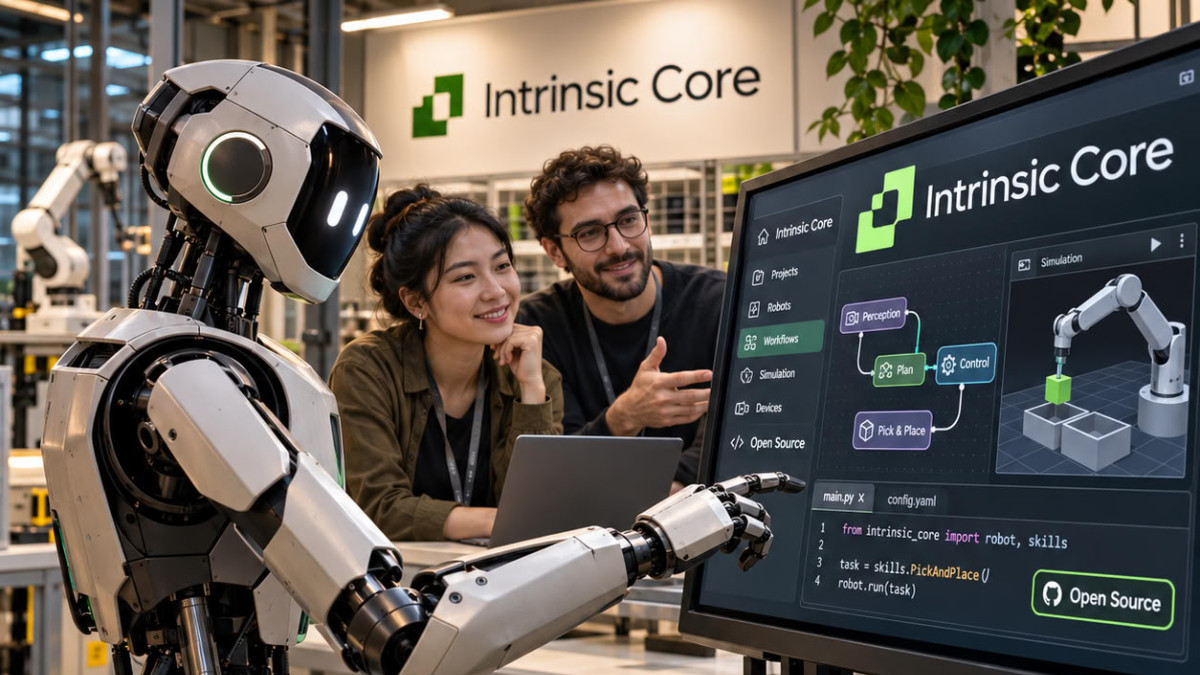

Intrinsic, Google’s AI robotics group, has announced the open-sourcing of part of its platform. Called Intrinsic Core™, this package bundles a set of capabilities compatible with ROS, a widely used open-source software framework in robotics, intended for creating sophisticated robotic applications.
- Intrinsic, the Google AI robotics group, has open-sourced part of its platform, called Intrinsic Core.
- This package is compatible with ROS and provides real-time control that does not depend on specific hardware.
- It includes tools for perception, motion planning, grasp planning, simulation, camera calibration, and ROS drivers.
- Intrinsic also published the Open Machine Tending Solution, a ready-to-use reference model, and the code is available on GitHub.
Adaptive and hardware-independent control
The first component, Intrinsic Control, is a real-time control framework that is not dependent on specific hardware. It enables sensor-based control: the robot can modify its behavior mid-trajectory when its environment changes. It is designed to produce efficient, collision-free paths. The goal is for users to be able to replace robotic arms, grippers, sensors, or other equipment without having to rewrite software drivers.
The package also includes several building blocks dedicated to perception and manipulation. The pose estimation provides an accurate estimate of the position and orientation of 3D parts across six degrees of freedom. The motion planning automatically generates efficient trajectories while avoiding collisions. The grasp planning aims to enable different grippers to automatically and dynamically adapt to a part’s position and orientation to grasp it with a higher probability of success.
Simulation, calibration, and drivers
The package also includes simulation services, which are meant to offer a simple way to test and troubleshoot robotic solutions, with updates as they are built. The camera calibration automates how a robot’s camera can be calibrated and physically aligned. Finally, the Intrinsic-ROS drivers are preconfigured and ROS-compatible for supported robots, grippers, and 3D cameras.
Alongside this package, Intrinsic has published the Open Machine Tending Solution (OMTS). This is a ready-to-use reference model for a concrete use case. According to the company’s presentation, its purpose is to give developers a starting point to customize, without having to start from scratch.
The Intrinsic Core code is available on GitHub, where it can be downloaded.
