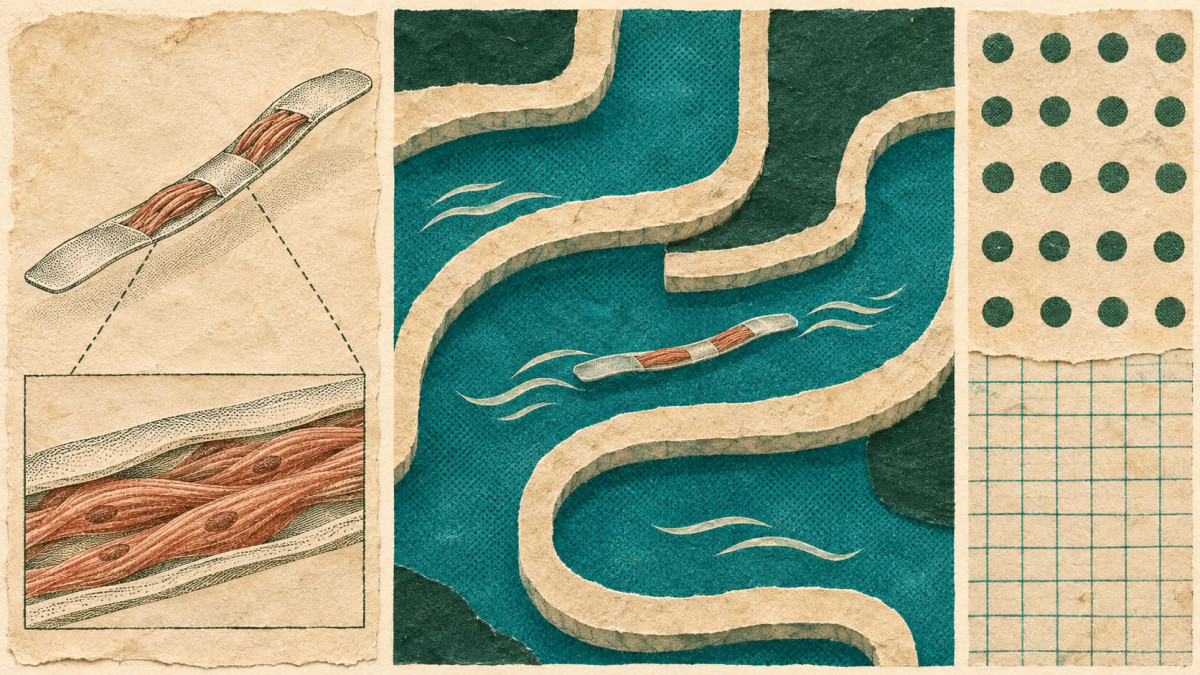

MIT engineers have designed an ultrafine swimming robot, whose fins are coated with a single layer of living muscle cells that contract in response to light. According to a study published in the journal Advanced Functional Materials, this robot can swim and turn through a simple aquatic maze.
- Des ingénieurs du MIT ont conçu un robot nageur ultrafin, dont les nageoires sont recouvertes de cellules musculaires.
- La lumière fait battre les nageoires, ce qui permet au robot de nager et de tourner dans un labyrinthe.
- Le robot atteint environ quatre fois sa longueur par minute, soit l’allure d’un requin de Mirabelle.
- Les chercheurs ont optimisé les sillons et le gel support, ce qui a renforcé la force musculaire.
The aquatic robot’s ‘skeleton’ is a gel film about the length and width of a stick of chewing gum. Its two halves form the device’s ‘fins.’ Each is coated with a layer of living muscle cells, thinner than a single strand of hair. These cells were genetically modified to contract in response to light.
When light shines on a fin, the muscles on its surface contract and the fin beats with enough force to propel the robot through the water. By alternating light flashes between one fin and the other, at different intervals, the researchers can control the device’s direction and speed.
At its top speed, the robot travels about four times its length in one minute. The figure is modest compared to Olympic swimmers, who can cover up to 65 times their length in the same timeframe. However, the robot can compete with slower swimmers, like the cow shark, which explores the ocean at roughly the same pace.
Ritu Raman, an associate professor of mechanical engineering at MIT and the study’s author, highlights the difficulty of the task: ‘It takes a lot of force to move through water rather than air. The robot is quite powerful, given its size.’ According to her, this is the first example of a very thin, two-dimensional robot, propelled by muscles and capable of movement.
Optimizing the Skeleton
The team’s previous work, conducted the year before, focused on a disc of artificial muscle inspired by the eye’s iris. For that project, the researchers printed concentric and radial grooves onto a gel disc, then deposited muscle cells onto it. This disc expanded and contracted in response to light, like a pupil. However, the movements remained very limited. ‘They only moved about 100 microns,’ explained Ritu Raman. ‘From a robotics perspective, their movements were tiny.’
To produce more force, the team sought to optimize the support on which the cells grow. In the previous device, the cells were cultured on fibrin, an ultra-soft gel that, according to the researchers, could quickly retract under the forces generated by the muscles. They therefore varied three parameters: the gel’s composition, its stiffness, and the size and shape of the grooves.
Tests showed that the cells aligned better in square-bottomed grooves than in curved grooves. Clearer alignment promotes the fusion of cells into fibers, which form stronger, better-coordinated muscle tissue. The researchers also replaced fibrin with gelatin methacrylate (GelMA), a material commonly used in tissue engineering. The cells aligned better and produced the most force on the stiffest gels. A half-millimeter-thick layer of GelMA proved sufficient to support a single layer of muscle cells without them detaching during contractions.
The final robot features two fins, with gel grooved on either side and lined with muscle cells. ‘You can think of the robot as having two independent muscles,’ explains Ritu Raman. ‘If you shine light on only one of the two, only that muscle moves. If you shine light on both, they both beat.’ In a large Petri dish filled with water, the researchers manually moved a light source, and the robot followed the light by beating its fins to navigate a maze.
The current form remains simple. The researchers first wanted to demonstrate that the robot could produce enough force to swim. ‘Our next goal is to optimize the body design to swim faster,’ states Ritu Raman. ‘But even at low speed, one could imagine a muscle-powered swimmer used for aquatic environmental monitoring.’ The work was supported in part by the Office of Naval Research.
