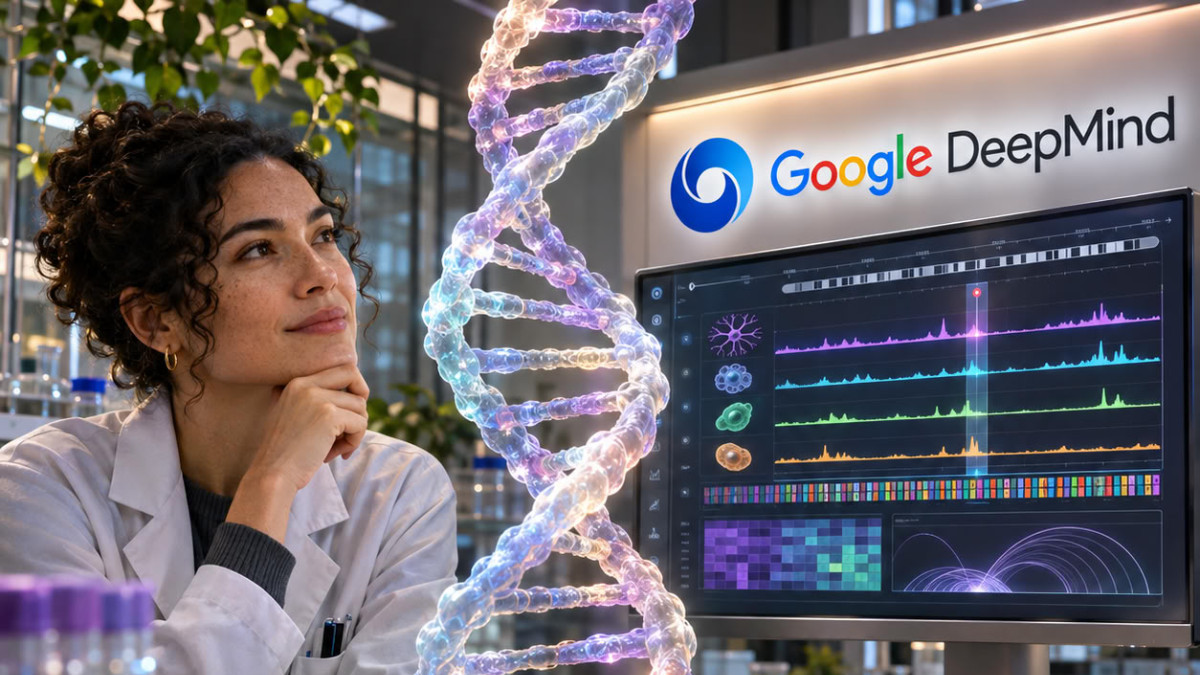

Google DeepMind has released AlphaGenome 2, a DNA model that predicts the effects of genetic variants in specific cell types. For now, it is only accessible via an API, and solely for non-commercial research.
AlphaGenome 2 is a conditional sequence-to-function model: it reads a 1 Mb window of DNA (1,048,576 base pairs, human or murine) along with a target cellular state. Its predecessor, AlphaGenome 1, produced predictions averaged over entire tissues. The new model distinguishes between closely related cell types and adapts to single-cell datasets without additional fine-tuning.
An architecture conditioned on cellular state
The model combines a convolutional encoder, an 11-block transformer, and a decoder, in a U-Net-like structure. Unlike AlphaGenome 1, which predicted in parallel for a fixed catalog of thousands of tracks, AlphaGenome 2 produces its outputs for a single condition per call. This condition is a 256-dimensional vector that modulates the network’s activations. According to DeepMind, conditioning the encoder and transformer accounts for most of the gain, with conditioning only the decoder or output layers yielding minimal improvements.
Training occurs in four stages: pre-training on bulk data and 3,977 single-cell tracks from 36 studies; fine-tuning only the condition vectors; distilling 8 ‘teacher’ models into a single ‘student’ model; and a post-training step that links a single-cell expression encoder to the model’s frozen condition space. This encoder was trained on over 100 million human scRNA-seq profiles, largely from CELLxGENE. Researchers can provide raw counts and obtain a condition vector, with documentation allowing up to 256 cells per call. Training used 2,048 TPU v4 chips, and the model weights will only be released upon final publication.
Results reported by DeepMind
On GTEx tissues, the median Pearson correlation for expression variation between tissues improved from 0.61 to 0.71. Within tissues, the variance in expression explained by cell type increased from 23% to 34% in scRNA-seq. The main result concerns single-cell eQTLs from TenK10K, covering 28 immune cell types: at 90% precision, AlphaGenome 2 recovers 30% of causal variants, compared to 16% for AlphaGenome 1 fine-tuned on this data. Recall for effect direction climbs from 23% to 43%.
On CRISPRi data held out for evaluation, the AUPRC for enhancer-gene links reaches 0.78, compared to 0.73 for AlphaGenome 1 and 0.61 for an ensemble of Borzoi models. The gap is most pronounced for enhancers located between 100 and 2,500 kb, with 0.62 versus 0.48. On an unseen Parkinson’s cohort not used during training, the model achieves a recall of 41%, compared to 17% for Scooby, fine-tuned on this cohort. These figures come from DeepMind’s evaluation, which also notes limitations: outside of accessible chromatin, the AUROC for predicting the sign does not exceed 0.63.
Access and resources
Colab tutorials are available via the API, and an API key is free for non-commercial use. Commercial research is under private access. The model is exposed in the Python package alphagenome, under alphagenome.models.v2. DeepMind has also released precomputed atlases: one covers enhancer-gene links for 640 primary cell conditions, the other scores approximately 7 million common variants and GWAS hits across 510 conditions.
