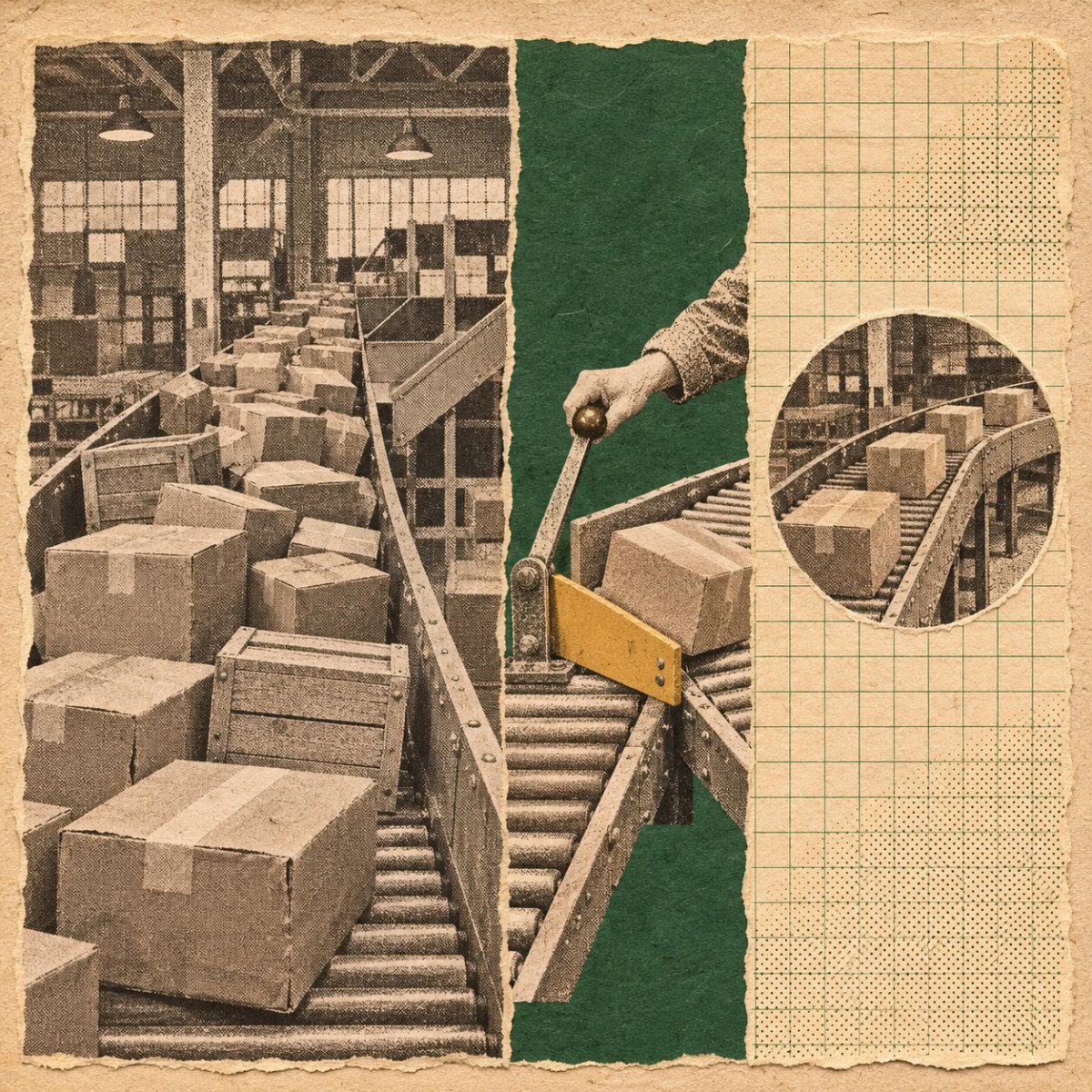

Across Europe, major delivery players are seeing their parcel volumes rise continuously, driven by e-commerce and consumer preference for home delivery or locker collection. Faced with this increase, maintaining warehouse flow continuity has become a central challenge, and solutions based on industrial vision and actionable AI-meaning AI capable of triggering a decision based on what it observes-are presented as a way to resolve blockages more quickly.
- Actionable AI triggers decisions based on what cameras observe.
- Photoelectric sensors cannot distinguish a temporary slowdown from a real blockage.
- False blockages stop shipping lanes unnecessarily and cause repeated interruptions.
- Industrial vision analyzes flows in real time and keeps parcels moving.
Logistics companies must contend with growing competition, the need to reach a critical size to preserve profitability, and constant cost pressure. Warehouses and distribution centers, meanwhile, are subject to increasingly stringent service-level requirements, fueled by ever-higher consumer expectations.
Delivery problems remain frequent. According to cited figures, on average, 35% of regular online shoppers in the European Union encountered a delivery problem in the past year. The most commonly cited issue was a longer-than-expected delivery time (20% of consumers), followed by receiving an incorrect or damaged product (11%). In France, 48% of consumers report having had problems with missed delivery deadlines or time slots.
A poor customer experience leads to refund or compensation requests, increases costs related to returns logistics, and undermines trust and loyalty. While investments often aim to speed up operations through automation, the question of their long-term sustainability remains just as important.
Never interrupt the flow
In high-capacity logistics centers, conveyors and automated sorting systems must operate without interruption, from receiving to shipping, including sorting, order picking, and packing. Every second of slowdown can cause a domino effect: parcels recirculated, throughput decreased, shipments delayed, and operational targets compromised. According to the source, 48% of logistics managers consider improving operational efficiency a priority over the next three years.
The cost of false alarms
Alerts signaling a blockage often trigger the same procedures, whether justified or not. When a temporary slowdown is interpreted as a blockage, certain shipping lanes may be stopped unnecessarily, and parcels must then re-enter the circuit. According to the article, false blockages cause repeated interruptions, alert fatigue, unnecessary team mobilization, and less predictable throughput.
From traditional sensors to actionable AI
Traditional detection relies on photoelectric cells, sensors that only distinguish between two situations: the line is blocked, or it is not. However, conveyors are faster, flows are denser, and parcels are more varied, so a simple slowdown can be mistaken for a real blockage. The described solutions rely on industrial vision, which allows for continuous analysis of a video stream or a rapid succession of images, to provide the context needed for automated decisions.
Installed above conveyors, cameras monitor flows in real time, while software analyzes speed, parcel density, and traffic patterns. If a blockage is detected, operators immediately receive an alert accompanied by visual evidence. In case of a false blockage, parcels continue their journey uninterrupted. According to the source, this approach reduces manual interventions and offers a quick return on investment, without requiring additional training for maintenance teams. Advances in AI and edge processing capabilities-meaning processing done directly on-site-are presented as what makes these solutions possible.
