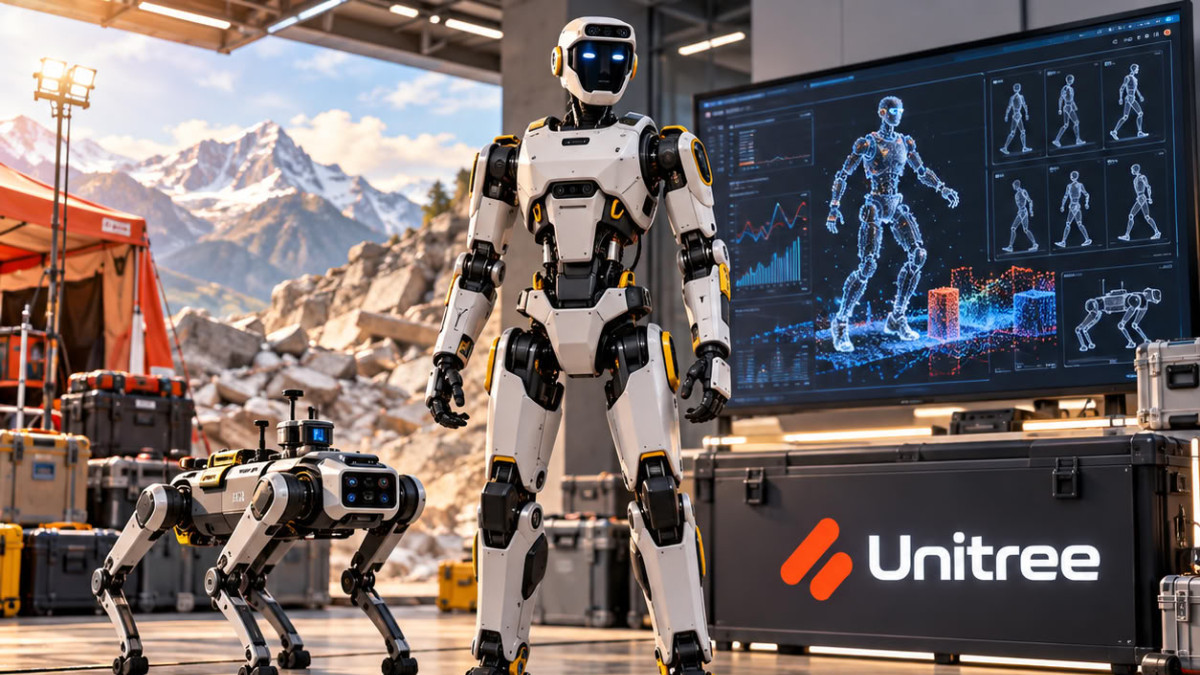

Unitree announces it has open-sourced its complete UnifoLM-WLA-1.0 embedded foundation model, which it presents as achieving new SOTA (state of the art) results on several benchmark tests among the free models available worldwide. This information is part of the weekly robotics video selection published by IEEE Spectrum, which also covers work from university labs and an interview focused on the industry.
According to Unitree, a single model coordinates desktop mobile manipulation and whole-body robot manipulation. The model is presented as capable of generalizing from one task to another and from one end effector to another, meaning from one gripping tool to another, all controlled by a single unified architecture.
Locomotion and Acrobatic Movements
Several academic teams are also featured in this selection. Researchers from ETH Zurich, via their Robotic Systems Lab, present a humanoid robot capable of traversing sparse three-dimensional structures, gripping parallel bars and jumping from one hold to another, like a monkey-bar, those children’s playground equipment. The challenge is to perceive fine, suspended geometries while executing precise whole-body movements.
Another team from ETH Zurich proposes a reinforcement learning framework, a method where the robot learns through trial and error, for locomotion that is both agile and generalizable across different terrains. It incorporates a map encoder based on the attention mechanism, which allows the control policy to account for the environment even when the view is partially obscured. Meanwhile, the DRAGON Lab at the University of Tokyo describes a multirotor aerial robot that combines impedance and admittance control to manipulate surfaces during repeated contacts, this work to be presented at IROS 2026.
From Urban Rescue to Industry
The selection also recalls the role of robots in rescue operations. According to the source, September 11th constituted the first documented use of robots for urban search and rescue, and helped give rise to disaster robotics. Teams began mobilizing on the afternoon of September 11th and worked on the rubble until October 2nd, when the last available robot broke down. These machines found no survivors, but they located remains and helped search for routes through the debris to basements and stairwells where trapped firefighters might have gone.
On a lighter note, Flexiv’s video on dishwashing sparked a reaction. The accompanying commentary suggests the demonstration avoids “many of the actually hard things” in this task, notably recognizing a dirty plate from a clean one. Finally, the selection highlights an interview with Péter Fankhauser, CEO and co-founder of ANYbotics, on the place of legged robots in industrial sites, their certification for explosive atmospheres, and the next steps in autonomous industrial work.
The calendar mentions the Humanoids Summit Seoul, from September 22-23, 2026 in Seoul, IROS 2026, from September 27 to October 1, 2026 in Pittsburgh, and CoRL 2026, from November 9-12, 2026 in Austin.