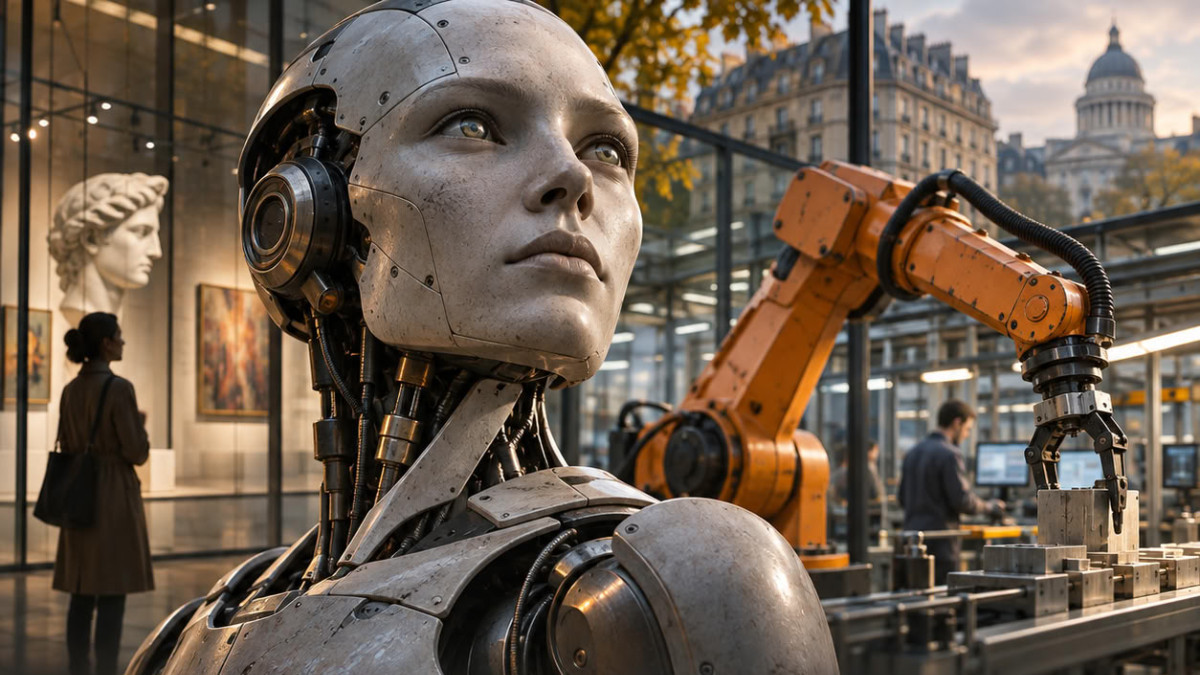

More than five million industrial robots are now operating in factories worldwide. At the same time, discussions on autonomous weapons have reached a milestone at the UN, and researchers at ETH Zurich have taught a robotic hand to walk on its fingers.
- Plus de cinq millions de robots industriels fonctionnent désormais dans les usines du monde.
- La Chine concentre 59 % des installations, tandis que l’Europe voit ses installations reculer.
- Le rapport de l’ONU sur les armes autonomes s’affaiblit, mais 76 États soutiennent des négociations contraignantes.
- Des chercheurs de l’ETH Zurich ont appris à une main robotique à marcher sur ses doigts.
Industrial Robotization on the Rise
Factories installed over 600,000 industrial robots in 2025, an 11% increase from the previous year, according to the World Robotics 2026 report by the International Federation of Robotics (IFR). The global operational stock grew by 9%. China, with 354,000 robots installed, accounts for 59% of the global total.
The United States surpassed Japan to become the world’s second-largest market, with nearly 38,500 installations. Europe follows the opposite trend: installations fell by 8% in Germany, 11% in Italy, 8% in France, and 15% in Spain. The IFR forecasts 655,000 units installed in 2026 and 806,000 in 2029.
For its part, Toyota told its investors that modernizing its group’s factories and those of its main suppliers could require around 400,000 robots. The program could cost ¥1 trillion, or approximately $6.4 billion, annually starting in 2028, although the group has made no firm spending commitment. In Chicago, at the IMTS trade show, Universal Robots also presented Gen 7, a cobot platform—robots designed to work alongside humans.
The Hands Behind the Machines
In Rajasthan, India, women are paid to film their domestic activities using cameras mounted on their heads, according to an investigation by the website Decode. The footage shows cooking, cleaning, or folding laundry from the worker’s perspective. These sequences can be broken down into elementary actions and used to teach robots how humans manipulate objects in real homes, a type of data considered particularly valuable.
Decode estimates that between 20,000 and 30,000 people could be engaged in this activity in India, a figure that remains an extrapolation and not an official count. The investigation does not specify which robotics companies ultimately receive these recordings.
Autonomous Weapons and Security Robots
After three years of discussions, the UN Group of Governmental Experts concluded with growing support for formal negotiations on new international rules. Human Rights Watch indicates that 76 states now support negotiations on legally binding measures. However, the final report was weakened: passages on ethical concerns and weapon design were removed or reduced following objections from states including Russia and the United States.
The issue will be reviewed at the Review Conference of the Convention on Certain Conventional Weapons in November, where states could decide on a negotiation mandate. Computer scientist Stuart Russell, in a short video from the University of California, Berkeley, called for a ban on small antipersonnel autonomous weapons. He warns that machines capable of selecting and attacking people could become cheap weapons of mass destruction, easy to deploy on a large scale.
A study published in the International Journal of Human–Computer Interaction examines, for its part, whether the perception of fairness can reduce conflicts between people and security robots. According to the authors, Xin Ye and Lionel Robert, distributive fairness concerns how fair the robot’s decision or its consequences appear, and informational fairness concerns the quality of its explanation. The researchers find that both can help reduce conflicts, although these results, from controlled research, do not prove anything about robots exercising authority in police operations.
A Hand That Walks
Researchers at ETH Zurich have taught an anthropomorphic robotic hand to walk on its fingertips. It uses reinforcement learning policies, a method where the system learns through trial and error, to crawl, steer, and get up after a fall. It can also support its own weight while pressing successive keyboard keys and push an object toward targets using top-down visual feedback. The work is the subject of an eight-page preprint on arXiv, and separate policies are used for each task.
