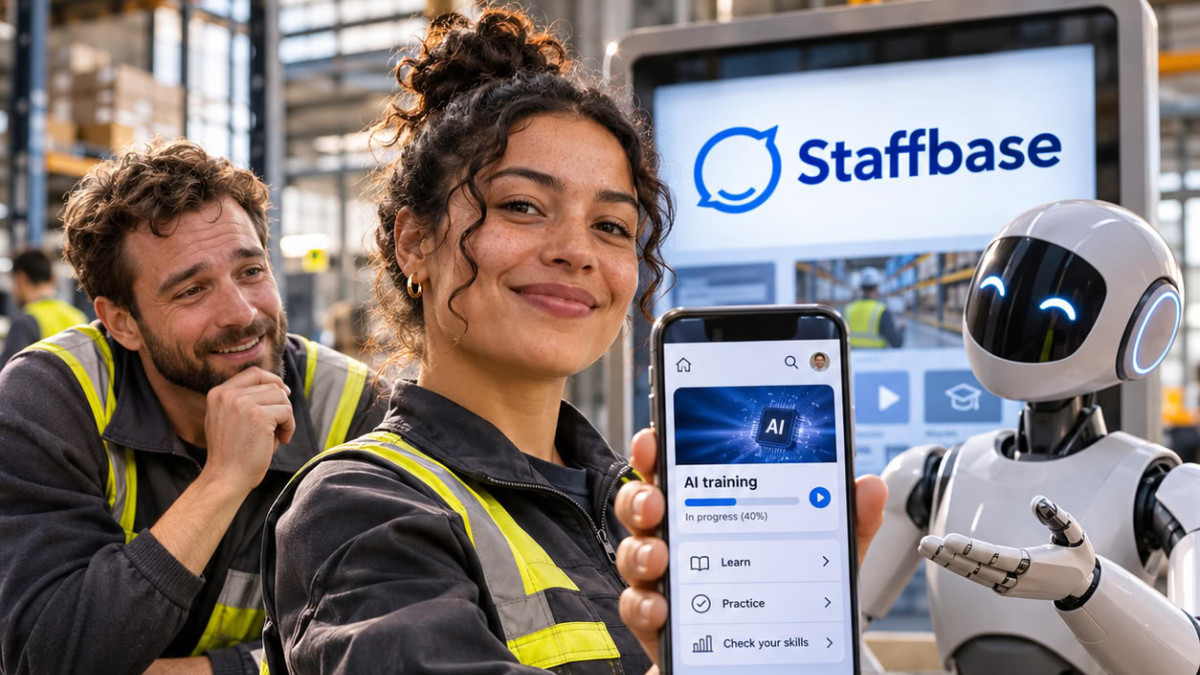

Many frontline employees, in stores, on production lines, or on the road, remain on the sidelines of the information campaigns their companies run on artificial intelligence. For Emmanuelle Loye, France Director of Staffbase, a publisher of a platform dedicated to the employee experience, communication teams must adapt their methods for these employees, who often have neither a computer nor a professional email address.
The deployment of AI affects many aspects of work, from how it is done to the tasks themselves. As the technology is recent and evolving rapidly, it often fits into a dynamic of transformation. It is therefore essential, in her view, that employees understand the reasons for the change, how it will happen, the benefit they will gain, and what is expected of them.
Reaching the “last mile”
Internal communication often finds itself powerless in the face of these teams. How to reach them, first, when they don’t have an email address? How to adapt messages to their habits, sometimes favoring audio or video, which are easier to consume on the go, over long written texts? And how to verify that key information has been seen or understood?
Lacking traditional tools capable of covering this “last mile,” these employees remain outside internal campaigns, which greatly reduces the contribution of communication teams to AI deployment projects.
Emmanuelle Loye presents AI as an opportunity to make frontline work smoother, with, in her view, better results in terms of speed, accuracy, scaling, or compliance. An assistant can provide access to company resources, whether it’s a customer service policy, a time-tracking tool, or an incident report, and add the employee’s context to each question, such as their job, geographic area, or hierarchical level. The answers are based on resources validated by the company. Audio formats, procedure summaries, or one-click leave requests complete this offering.
Training without burdening daily work
In her opinion, training must be adapted to the field, where employees don’t have time for long sessions. Short formats, accessible on mobile, available offline and in their language, are more appropriate, for example a few minutes before or after a shift.
The most effective training remains, still according to her, that which is linked to daily tasks. Internal communication then plays a bridging role, by offering training within the application that employees already use and ensuring follow-up to know who has actually acquired knowledge. She also recommends: “My advice: go to the field before designing anything. Analytical data reveals what is happening, but an on-site visit allows you to understand the reasons.”
Faced with AI tools that some employees already use on their personal smartphones, called Shadow AI, the response involves an official alternative that is just as easy to use, without a professional email address, and based on validated knowledge bases. Short guidelines, written without legal jargon, should also specify what employees can or cannot enter into public tools.
Collaborating with HR and IT
Each function brings an essential part according to her: IT masters the technology, HR understands the people who will use it, and communication knows the processes that connect the two. She adds operational management to this joint work, which must precisely define the need it addresses. “Technology is a tool, not an end in itself,” she states.
She also insists on trust and respect for everyone’s expertise, specifying that each must first focus on their own domain. Finally, stakeholders must agree on success indicators. Beyond traditional reach or engagement metrics, internal communication can integrate indicators linked to the operational or organizational challenges of AI adoption.
