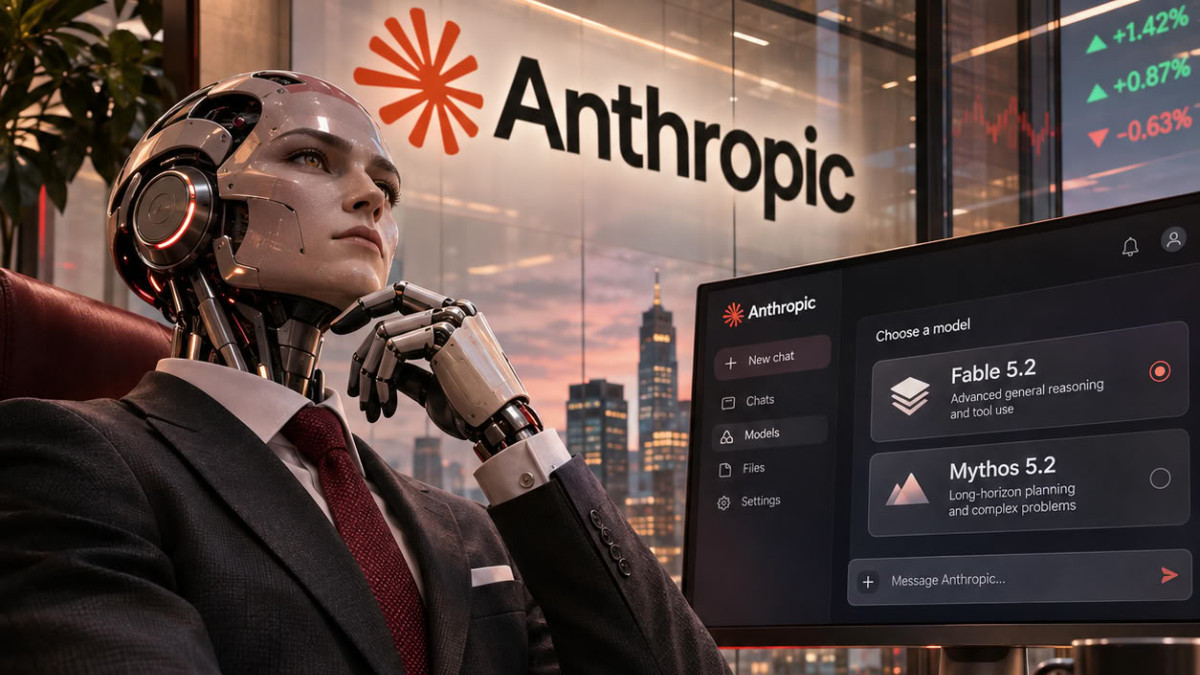

Just months before its stock market listing (IPO), the publisher of Claude unveiled the new version of its most powerful model on Monday, November 9. Available in two variants, Claude Fable 5.2 and Claude Mythos 5.2, it shows improvements in coding, reasoning, and vision, and targets scientific research and robotics. The price has been lowered.
- Anthropic dévoile Fable 5.2 et Mythos 5.2 peu avant son entrée en bourse.
- Les deux variantes reposent sur un même modèle, mais Mythos offre des capacités cyber renforcées.
- Fable 5.2 progresse en codage et en robotique, mais reste derrière Gemini 4 Carbon en automatisation.
- Le prix baisse d’environ 20 %, mais le coût par tâche reste plus élevé que chez les concurrents.
Claude Fable 5.2 is intended for the general public, while Claude Mythos 5.2 offers enhanced cyber capabilities for selected organizations, as part of verification programs in cybersecurity and life sciences. Both variants are actually based on a single, identical model. The difference lies mainly in the safeguards applied to their outputs: Mythos can perform advanced cybersecurity and biology tasks, whereas Fable 5.2 applies strict safeguards and often refuses to answer.
A model presented as universal
Anthropic positions Fable 5.2 as a model suited to all complex tasks, not just as a simple coding benchmark model. On the FrontierCode 2.0 benchmark, it scores 49.1% in agentic coding, compared to 45.5% for Claude Opus 5.5. In bug resolution (FrontierSWE v2), it reaches 69.9%, versus 62.3% for Opus 5.5. In web research (WANDR, relaxed score), it achieves 82.1%, compared to 72.3% for Opus 5.5.
In business workflow automation, however, it remains behind Gemini 4 Carbon, with 51.4% versus 53.9% on AutomationBench. The reported data also places it ahead in vision and computer use, with more modest leads.
Robotics and scientific research
The most significant gains concern robotics. On RoboDojo Sim, a robotics simulation test, Fable 5.2 scores 64.9%, compared to 39.4% for Opus 5.5 and 29.8% for GPT-6 Astra. In autonomous scientific research (Terminal-Bench-Science 0.1), it reaches 74.6%, versus 68.1% for GPT-6 Astra.
According to published details, Fable 5.2 autonomously solved two open questions in physics concerning black holes. For its part, Mythos 5.2 orchestrated two open-source models to predict the structure of AAV capsids, the envelope of viruses used in gene therapy, with 28 successes out of 34. A team of 1,000 Fable 5.2 agents computer-verified the proof of Fermat’s theorem in 30 hours, whereas Opus 5.5 had only completed 26% in 18 hours. Anthropic also claims its model can generalize to certain situations not learned during training, a capability leading some researchers to question the long-term relevance of world models, those models that simulate how the world works.
A lower price, a higher cost per task
Anthropic announces a price reduction of around 20% compared to Claude Fable 5.1, to $8 per million input tokens and $40 for output, versus $10 and $50 previously. A token is a unit of text processed by the model. According to Artificial Analysis, however, the model remains more expensive on the tasks tested. For the organization’s index, a task costs about $6 with GPT-6 Astra, around $10 with Opus 5.5, and nearly $27 with Fable 5.2.
The model is also up to 30% faster than Fable 5.1, with about 98 tokens per second in max reasoning according to Artificial Analysis, versus 77 for Gemini 4 Carbon. It can consume up to 50% of the weekly usage limits on standard Pro and Team subscriptions.
This positioning fits within the perspective of the IPO. Anthropic is now targeting new sectors, such as scientific research, biology, and robotics, which could, according to the analysis from which this information is drawn, broaden its customer base and recurring revenue ahead of the stock market listing.
