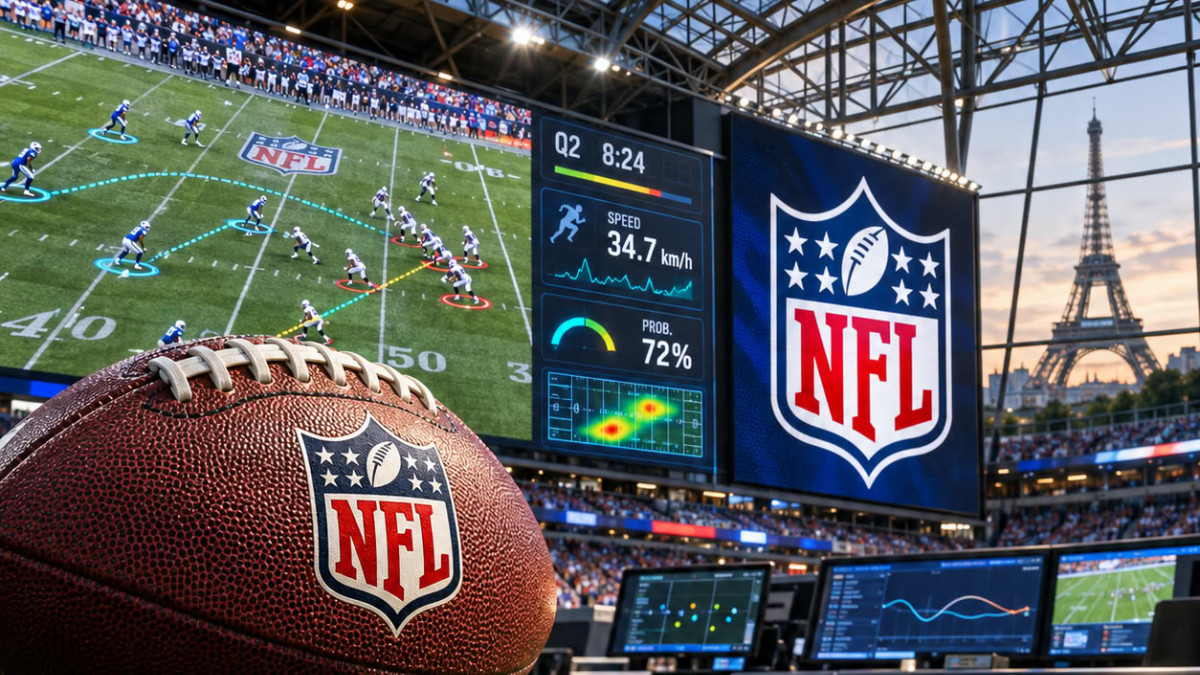

France hosted its first-ever NFL game on Sunday at the Stade de France in Saint-Denis, between the Pittsburgh Steelers and the New Orleans Saints. Behind the sporting spectacle lies a system based on sensors, the cloud, and artificial intelligence, making the American football league an advanced player in real-time data processing.
On the field, runs and passes dictate the pace of the game. But statistics have long held a central place in this sport. What has changed are the technical means. First, a seemingly simple problem had to be solved: in massive scrums of players, traditional cameras easily lose track. Hence the idea, launched about fifteen years ago, of equipping players with sensors to ensure signal continuity.
“With a wearable sensor, the data stream remains constant,” explains Josh Helmrich, head of Next Gen Stats at the NFL. Tracking started nearly twelve years ago, hosted in Amazon’s cloud, before a partnership with AWS to move to machine learning. To digitize the game live, the NFL relies on an ultra-wideband (UWB) local network, developed with Zebra Technologies. Each player wears two to three RFID sensors in their shoulder pads, and linemen wear three more. The official ball, supplied by Wilson, also contains a chip.
Several hundred sensors continuously transmit to the 21 to 22 receivers installed high up in the stadium. The stream goes to a server, then to the AWS cloud, where it is stored, processed, and distributed to broadcasters. “From chips to the cloud, then to broadcast: everything executes in less than a second,” boasts Armel Negret, head of the sports market at AWS France. Player positions are updated ten times per second, the ball’s position twenty times. By coupling this data with computer vision, the league even reconstructs a complete 29-point athlete skeleton, a 3D model intended for television and some explanatory videos.
A Temporary Data Center Installed in a Stadium
Making this system work in American stadiums designed for it is routine. Deploying it in venues not prepared for it is another matter. In Paris, as in London at Tottenham Hotspur Stadium, technical teams had to transform the locations. “When they arrive at a venue like the Stade de France, our teams turn it into a gigantic data center,” explains Gabie Boko, global marketing director at NetApp. This California-based company provides the NFL with the storage, protection, and delivery architecture for the game feeds.
The schedule is tight. “All the equipment, cameras, servers are delivered at least 30 days before the event,” details Gabie Boko, who indicates everything is dismantled within a week to move to the next game. Josh Helmrich acknowledges that the only concrete difference to consider concerns radio frequencies, which vary from country to country. Data sovereignty and security are also essential. This data remains the property of the NFL and is not transmitted in real-time to coaches on the sideline, who only have access to photos of each play. The league prohibits access to real-time data, live video, or the internet, for reasons of sporting fairness.
Data for Broadcasters, Teams, and Health
Once secured by NetApp, the raw data goes to AWS to feed the Next Gen Stats. According to Armel Negret, the metrics visible on screen are “only the tip of the iceberg.” AWS’s machine learning generates over 500 metrics per play. To encourage analysis, the NFL organizes the Big Data Bowl, a hackathon designed with AWS. During one edition, a Japanese duo developed a model for predicting rushing yards gained, now used as the official basis for the league’s statistics.
This tracking also serves injury prevention, as part of the “Digital Athlete” medical research program developed with AWS. Tracking data is cross-referenced with the equipment worn by players. It has already led to rule changes on kickoffs to limit high-speed collisions and concussions, and has allowed equipment manufacturers to design position-specific custom helmets.
