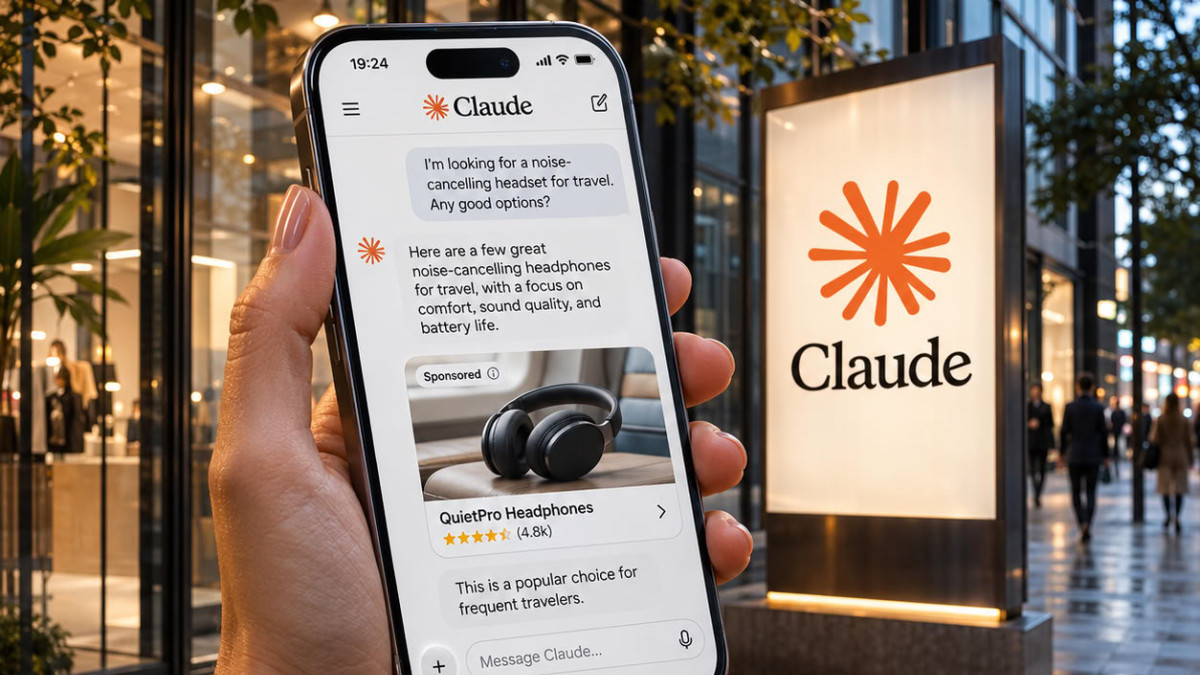

Anthropic is keeping the promise made in its Super Bowl ad spot: its chatbot Claude remains ad-free. The filing for its initial public offering doesn’t even mention the possibility of selling ads to fund the service. Meanwhile, the chatbot sector seems increasingly tempted by this model to cover the high cost of AI-generated responses.
- Anthropic garde Claude sans publicité, alors qu’OpenAI et Google vendent déjà des annonces.
- La publicité devient essentielle pour les chatbots de niche, qui n’ont pas les financements des grands laboratoires.
- Selon Koah, les annonces rédigées en partie par l’IA génèrent deux fois plus de clics.
- Les chatbots permettent de cibler les annonces grâce à tout le contexte de la conversation.
Anthropic can afford this stance, with around $112 billion in cash brought in by its investors. For other players, advertising could become essential. OpenAI has gone down this path: over 100,000 customers have been advertising on ChatGPT since ads launched on the platform in February. Last week, Google expanded ads in its AI Mode search chatbot to ten more countries, in addition to the US, and claims users “find these ads highly relevant.” Advertisers aren’t fully satisfied with the experience yet, but they expect improvements.
Advertising could be particularly important for niche chatbot platforms, which can’t rely on the same fundraising as major AI labs or the substantial revenues of tech giants. Koah Labs, a San Francisco startup, is among the new ad tech companies focusing on AI experiences. According to the company, its ads are served in over 200 apps, including DeepAI, which offers tools for creative queries, and Liner, which provides sources in its responses. Koah works with the telehealth giant Hims and the flower delivery service UrbanStems.
Koah has ten times fewer advertisers than OpenAI, but its CEO, Nic Baird, believes he has a good idea of what works and what remains unclear. According to him, ads written partly by AI generate twice as many clicks as those written entirely by a human. He acknowledges it’s difficult to explain precisely why, though these texts likely seem more natural alongside an AI model’s responses.
Koah’s ads are based on product information and visuals provided by the advertiser, which, according to Nic Baird, limits the risk of users encountering erroneous information invented by the AI. Some advertisers, like pharmaceutical companies, are subject to government mandates on what they must or must not say. They therefore favor more human control over their ads, which, again according to Nic Baird, yields poorer results.
More creative targeting
A Google search for “help with stress” typically shows ads for therapists. Chatbots, according to Nic Baird, allow for going further. In Koah’s network, ads for spas, for example, performed well when displayed after queries related to “stress.”
The difference, he says, lies in the ability to select and adapt the ad based on “not only the query or the Google search, but also the AI platform’s response, which provides the context of the rest of the conversation.” Furthermore, queries to chatbots are at least twice as long as Google searches, offering more information to determine a relevant ad.
