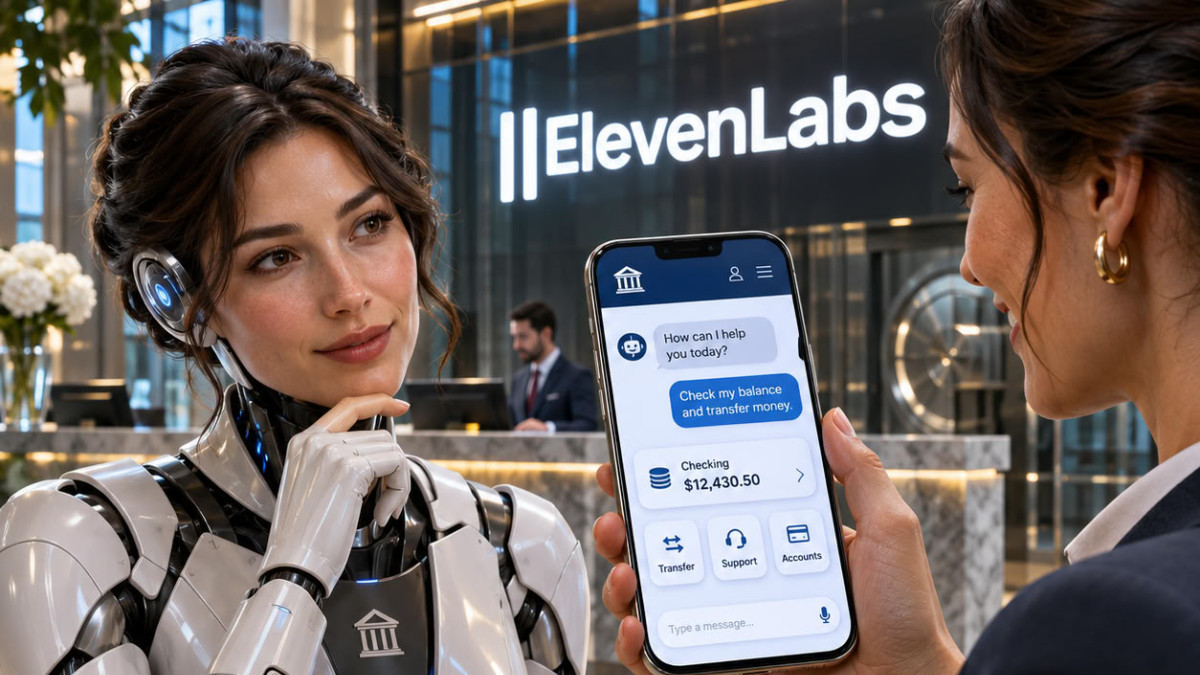

Banks often offer short and restrictive opening hours, which compete with customers’ workdays and schedules. According to a guide published by ElevenLabs, conversational AI makes it possible to offer 24/7 service without increasing operating costs. However, the document notes that the rapid rollout of chatbots is not necessarily an asset, citing a report from the U.S. Consumer Financial Protection Bureau (CFPB).
According to this report, published in 2023, the top ten U.S. banks had already integrated chatbots into their processes, and more than a third of Americans had interacted with these bots. However, the CFPB identified problems in their operation, which, according to the guide, makes real resolutions and clear transfers to a human advisor all the more important.
These agents differ from rule-based chatbots, which follow rigid scripts. They handle requests formulated in natural language, consult account context, and carry out procedures, such as verifying a customer’s identity or handling a payment dispute. They only transfer to a human situations they cannot resolve, or when the customer explicitly requests it.
A phone call, step by step
The guide details the process of a call handled by a voice agent. Before communicating any information, the agent identifies the caller by consulting their file in connected systems, such as a customer relationship management (CRM) tool or the bank’s core system. Each institution sets its own verification requirements.
To understand the request, the Scribe v2 transcription tool transcribes speech in over 90 languages, and adding key terms allows for the integration of product names or banking terms. On the response side, ElevenLabs announces a response time of around 100 milliseconds for Eleven v4 Turbo. In a benchmark conducted in September 2026, the model showed a median latency of 142 milliseconds between request and audible speech, while competing text-to-speech (TTS) models, tested with identical scripts and their default settings, ranged between 262 and 814 milliseconds.
Callers often interrupt or change their minds mid-sentence. According to the guide, a model dedicated to turn-taking allows the agent to stop mid-word, take the correction into account, and answer the new question. Vulnerable customers, complaints, and suspected fraud, on the other hand, must be transferred to a human advisor, with a summary of the conversation.
Security, Compliance, and Results
Banks must check their suppliers’ certifications: SOC 2 Type II, which attests to independently audited security controls; PCI DSS, for payment data processing; and ISO 27001, the benchmark for information security management. Zero Retention mode provides for data to be deleted immediately after necessary tasks are performed. The guide also notes that the GDPR regulates transfers of personal data outside the European Union and the European Economic Area, and that FINMA sets requirements for Swiss banks.
According to McKinsey & Company, cited by the guide, conversational AI reduces average handling time by 10 to 20% and overall call volume by up to 40%. The CEO of KeyBank told investors in early 2026 that an AI-handled call costs about 35 cents, compared to about $9 for a human-handled call.
The guide also cites Customers Bank, a $25 billion U.S. bank, which deploys three agents, including one for onboarding new customers. Klarna launched a voice agent as the first tier of its phone support for its 35 million U.S. customers, and the company reports resolutions up to ten times faster for requests handled by this agent. The document finally notes that banks generally limit the actions an agent can take on its own.
