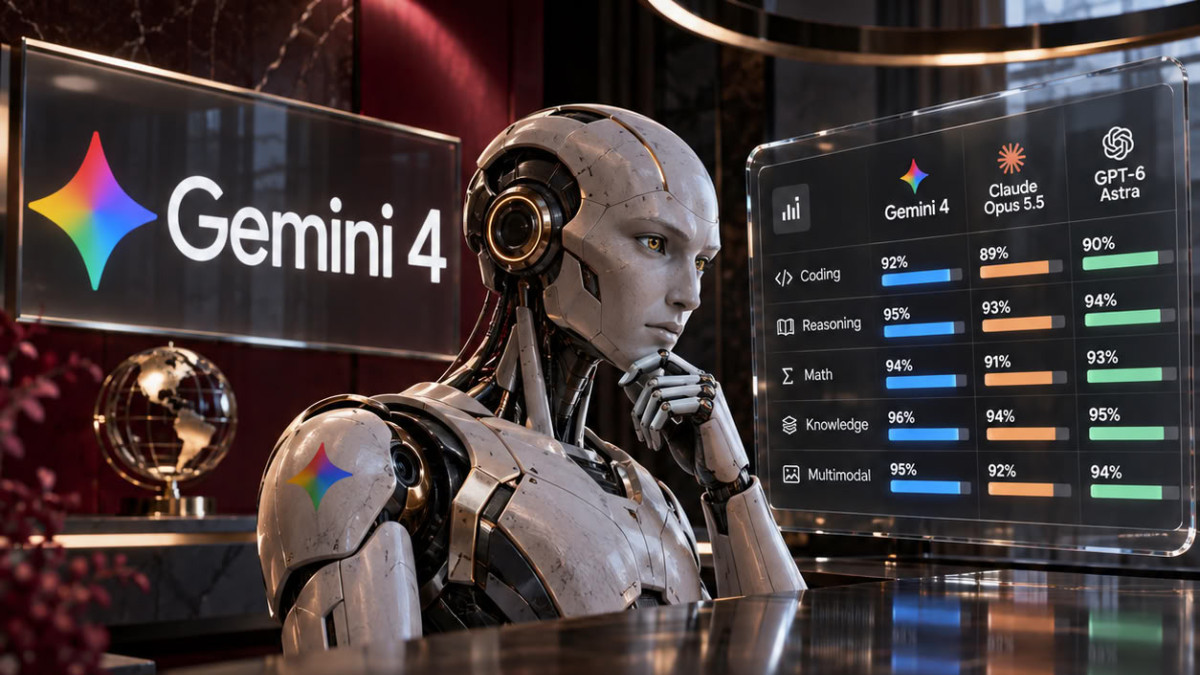

Google is back in the race for cutting-edge AI with Gemini 4 Argon, available since October 13. According to benchmarks published by the company, this model rivals OpenAI’s GPT-6 Astra and Anthropic’s Claude Opus 5.5, and it aligns with the latter’s pricing grid. The JDN put it through three practical tests, the results and costs of which are detailed below.
A generalist model, according to benchmarks
Unlike Claude Opus 5.5 or GPT-6 Astra, Google is not targeting only developers. Gemini 4 is presented as an everyday model, intended for business teams, researchers, and developers. On terminal code (Terminal-Bench 4.0), it reaches 57.4%, on par with GPT-6 Astra (58.2%) without surpassing Claude Opus 5.5 (66.4%). It takes the lead in software engineering with 77.9% on DeepSWE v1.1, as well as on mathematical reasoning (76.0% on RiemannBench) and long video analysis (91.7% on LVBench). OpenAI, however, retains the advantage in autonomous scientific research, with 68.1% on Terminal-Bench Science 0.1.
Prices aligned with Claude Opus 5.5
Per million tokens (units of text processed by the model), Gemini 4 Argon charges $4 for input, $20 for output, and $0.20 for cache read, amounts identical to those of Claude Opus 5.5. GPT-6 Astra is listed at $10, $50, and $1.00. Until November 30,2026, Google is applying a launch price of $2 for input and $10 for output. To go lower with OpenAI, the source indicates one would need to turn to GPT-6.1 Sol.
Three tests, mixed results
For creating a landing page, the best version is GPT-6 Astra’s, judged to be both futuristic and informative. Claude Opus 5.5 offers a more interactive experience, but its interface appears less professional. Gemini 4 Argon produces a page very dense with information, but its low contrast harms readability.
On a 500-word first-person text in French, the JDN judges Claude Opus 5.5 to be the most natural. GPT-6 Astra is the most literary, but mixes the passé composé and passé simple tenses. Gemini 4 Argon produces the most generic text, marked by recurrent AI phrasing.
For a 10-second motion design clip created with the Remotion library, Claude Opus 5.5 and Gemini 4 Argon stand out. Claude’s video is judged the most convincing, while Gemini 4’s presents realistic visuals but an information overload.
In terms of costs, Gemini 4 is the cheapest for a single-turn text, at $0.05 at the standard rate versus $0.06 for Claude Opus 5.5. As soon as the task involves an agentic workflow with tools, the bill climbs: the total reaches $5.52 at the standard rate, compared to $1.43 for Claude Opus 5.5 and $2.50 for GPT-6 Astra. According to the JDN, Gemini 4 rewrites its entire file with each correction, and its files are up to four times longer than those of its competitors.
