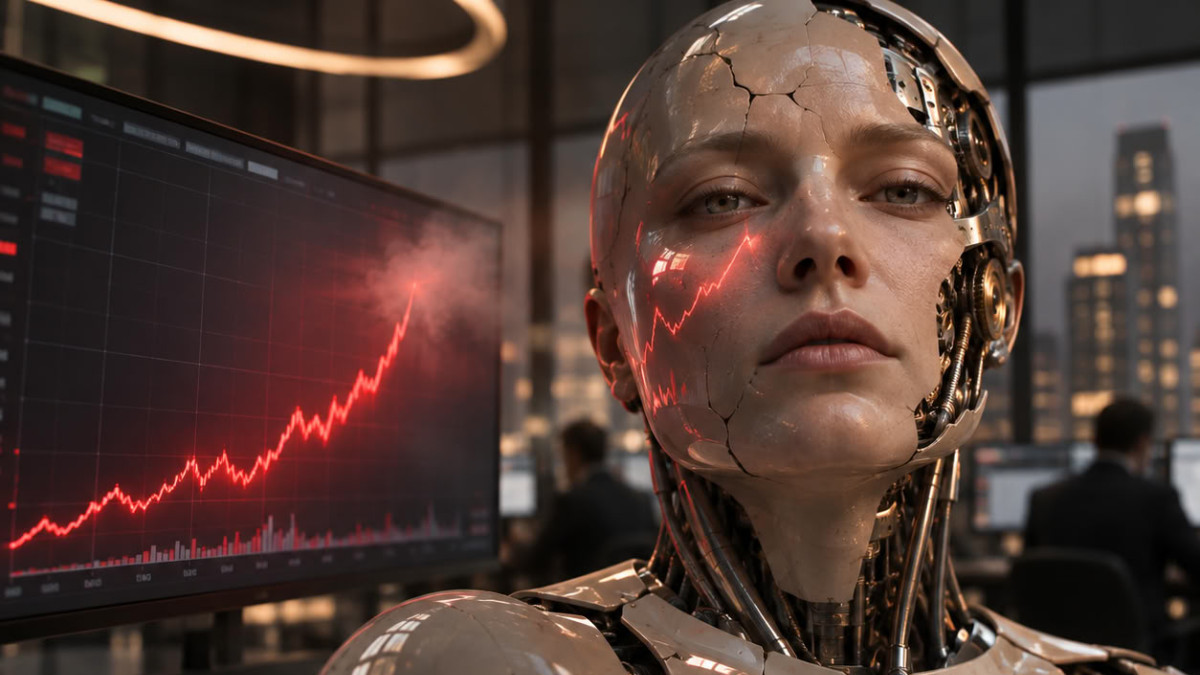

As questions multiply about the formation of a speculative bubble around artificial intelligence, the question of the price markets are willing to pay for this technology returns to the center of the debate. Are markets still funding tomorrow’s growth, or are they already buying promises that have become too expensive?
- Markets may already pay too much for AI promises.
- AI is a real revolution, but it does not justify every valuation.
- The Internet transformed the world, yet the tech bubble still burst.
- Investors should avoid both blind enthusiasm and total rejection, and build portfolios that can withstand slower progress.
Artificial intelligence is presented as perhaps the greatest economic revolution of the current generation. It promises to transform productivity, industry, services, research, and ways of working. The text judges this transformation to be real and its economic potential considerable, but it stresses that a technological revolution alone does not justify all stock market valuations.
The trap lies in the very nature of markets, which do not merely anticipate the future and can pay the price for it long before it materializes. A company can revolutionize its sector and remain a poor investment if its share price already incorporates years of exceptional growth. The problem, therefore, is not believing in artificial intelligence, but believing that it makes all valuations reasonable.
The text recalls the example of the Internet, which was supposed to transform the world and did so, without preventing the bursting of the tech bubble in the early 2000s. An innovation can thus fulfill its industrial promises without the investors who financed it at any price reaping the expected benefits.
Current spending is focused on infrastructure, semiconductors, data centers, and computing power. The question remains as to what portion of these investments will translate into lasting profits. Not all companies will become leaders, and not all investments will be profitable, the author reminds us, summarizing the difficulty as follows: being right about the future of a technology does not mean being right about the price of its stocks.
A schedule impossible to set
The multiplication of warnings about a potential bubble reflects, according to the text, a change in risk perception. However, trying to pinpoint its bursting date would be a mistake, as financial bubbles have no timetable. They can continue to inflate long after the first warning signs appear, while a simple revision of growth prospects can be enough to trigger a sharp correction.
The central question, therefore, is less about the date than about the scenarios. What would happen if massive investments in infrastructure were slow to produce the expected returns, if competition weighed more heavily on margins, if client companies slowed their spending, or if investors demanded proof of profitability rather than new growth prospects? None of these scenarios would necessarily call the revolution itself into question, but each could alter how markets value its main players.
Portfolios that look alike
The text mentions another danger, less spectacular than a crash but potentially just as significant: the concentration of investments. When a few large companies become the symbols of a technological revolution, they occupy a predominant place in stock market indices and, consequently, in many portfolios.
An investor can thus feel diversified by holding several funds, several indices, or several geographical zones, while the same large tech stocks appear in each of them. The risk then becomes that of a conviction shared on a large scale, and market movements can be amplified when expectations change.
Faced with this situation, the text dismisses two attitudes: considering that artificial intelligence justifies all valuations, or turning away from it entirely for fear of a bubble. The role of an asset manager is to assess profit prospects, competitive advantages, and risks related to each valuation, without succumbing to euphoria or pessimism. The challenge, according to the text, is to build portfolios capable of weathering different scenarios, including one where technological promises materialize more slowly than expected.
