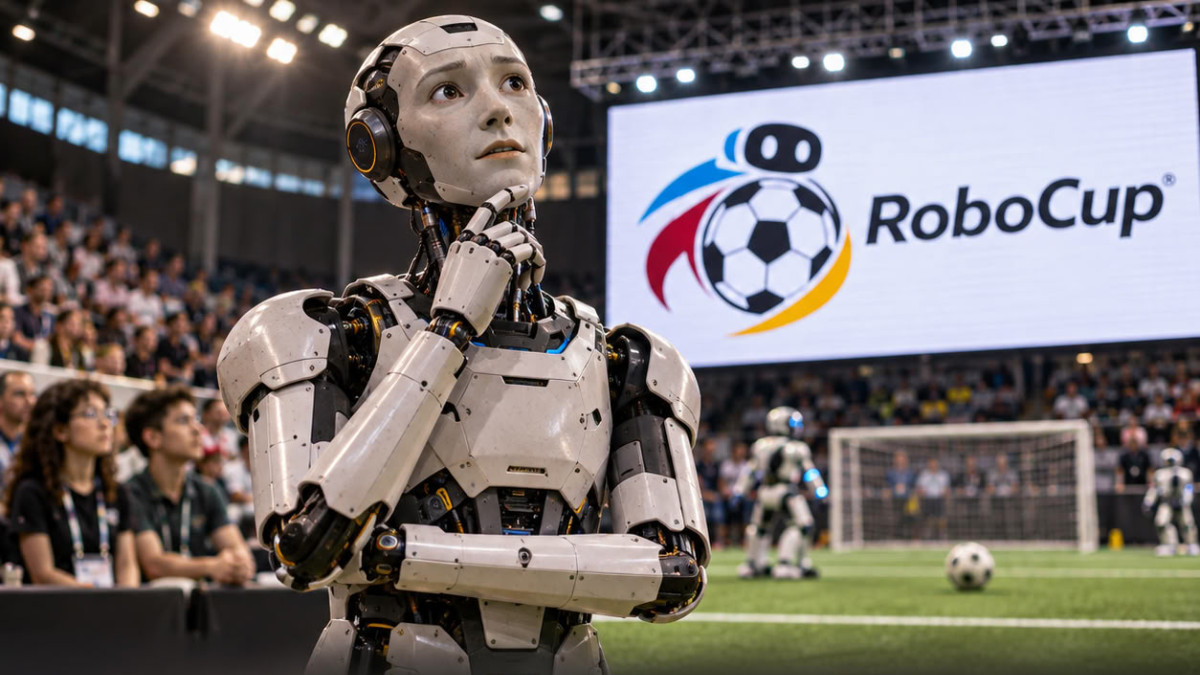

Humanoid robots have made significant progress in recent years, as shown by the RoboCup 2026 competition, which has just been held. During a discussion bringing together several robotics and artificial intelligence researchers, organized by AIhub, participants wondered, however, whether this form is truly the most suitable, and whether the spectacular demonstrations reflect the machines’ real capabilities.
Rapid progress on the field
According to Joydeep Biswas, from the University of Texas at Austin, the situation began to change two or three years ago. The new humanoid robots presented at RoboCup fell less often and could operate without being followed by humans. He attributes this leap to the combination of several factors: much better hardware, algorithmic advances, and new training methods. Walking is now often controlled by learned controllers, rather than by classical command. Models are trained in simulation then transferred to the real world, a technique called sim-to-real.
The 2026 edition brought together 55 humanoid soccer teams, a number that Mr. Biswas considers high for an international competition. During an 11 vs. 11 demonstration match, the robots faced the RoboCup trustees. “There was a time when it was trivial,” he said. “I won’t say it was difficult this year, but it is becoming less and less easy for the trustees as the years go by.” The federation has also simplified its championships: in 2028, only the humanoid soccer league will remain.
A form not suited to all tasks
For Mr. Biswas, a humanoid is rarely the most suitable solution. A simple task, such as grasping an object and moving it, is easier to perform with a wheeled robot, whose base is stable. With a humanoid body, planning must also take into account forces, speeds, and accelerations, which greatly increases complexity.
Sabine Hauert, from the University of Bristol, believes that a set of specialized robots, working together, could offer the same capabilities as a human “through multiplication rather than by combining everything into a single agent.” Rina Dechter, from the University of California, Irvine, nuances this point, however: for health assistance, a humanoid form could give people a better impression. Marija Slavkovik, from the University of Bergen, reminds us that science fiction has largely shaped the image of the humanoid robot.
Demonstrations and the gap with reality
Mr. Biswas warns against promotional videos, whose filming conditions are not always specified. He questions the number of takes required, the degree of system tuning for a specific scenario, and the robustness in the face of a simple change of brush or lighting. According to him, the best advances are often highly optimized for particular scenarios and are not versatile. He also believes that the data needed for general use is lacking. He cites teleoperation, where a human pilots the robot to generate training data, a field in which many companies are investing “millions to billions of dollars.” He doubts, however, that this data is sufficient, recalling the comparison with self-driving cars and HD maps.
For a product, the reliability threshold is, according to him, very high: “In research papers, we say an 80% success rate is phenomenal. No, an 80% success rate as a product is awful.” He adds that “even 99% is not enough.” When asked about the domestic robots announced by three companies, he replies that none can accomplish all household tasks alone and that these devices serve in part to collect data.
