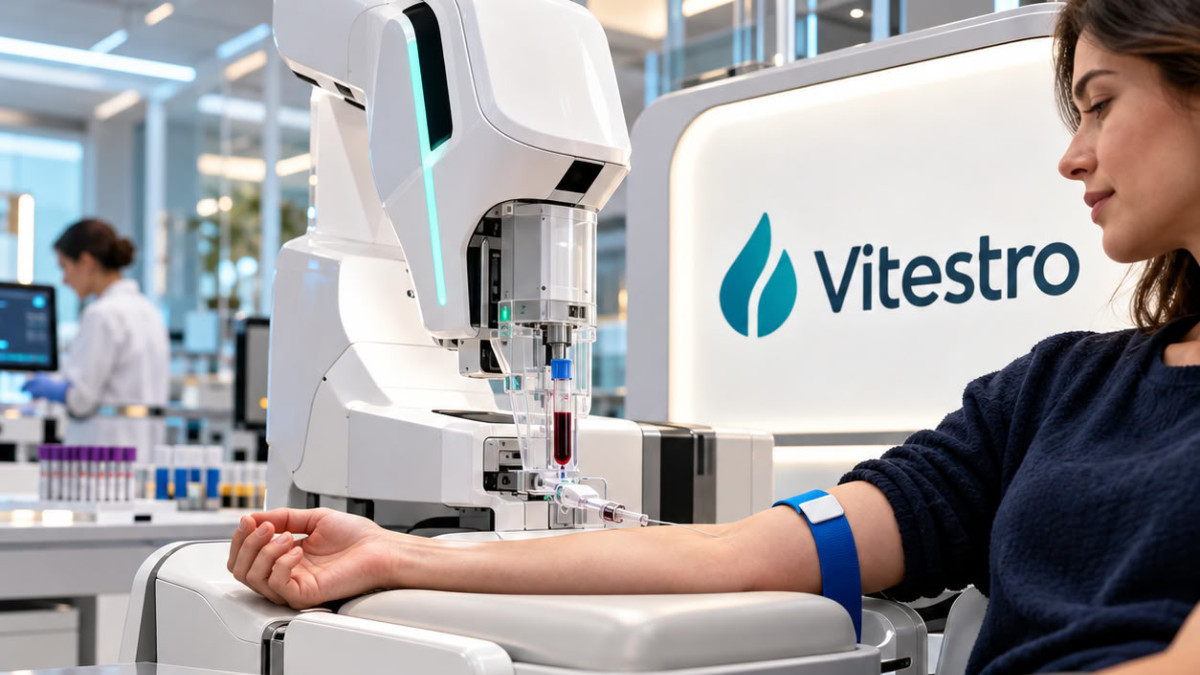

The FDA, the U.S. agency for drugs and medical devices, authorized on August 19 the use of Aletta, presented as the first autonomous blood collection device approved in the United States. Developed by the Dutch medical robotics company Vitestro, the device is intended for adults in non-hospital settings.
The patient sits down, places their arm in a cradle, and presses a button. Near-infrared light locates a vein in the crook of the elbow, an ultrasound probe measures its depth and direction, while a Doppler sensor checks the direction of blood flow to avoid the artery. The needle is then inserted automatically, without human intervention. The system combines imaging, robotics, and artificial intelligence to algorithmically perform what a phlebotomist does, that is, a healthcare professional trained to find veins and draw blood by hand.
European authorities had given the green light to the device two years earlier. For Max Balter, a specialist in surgical robotics at Medtronic, one must ‘tip one’s hat’ to Vitestro. He adds: ‘The engineering they have is incredible… and with FDA clearance, it moves the whole industry forward.’
Clinical results and a response to staff shortages
In a clinical trial conducted in the Netherlands with over 1,600 people, Aletta successfully performed the blood draw on the first attempt in 94.5% of cases. This result also applies to patients with difficult-to-access veins, obese individuals, and the elderly. When the device cannot identify a suitable vein, the patient is referred for a conventional blood draw.
Joe El-Khoury, a clinical chemist at Yale who was not involved in the Dutch trial, speaks of ‘exceptional performance,’ estimating it is ‘just as good, if not better’ than that of a typical professional phlebotomist. Complications are few, according to reported data, and several safety devices, including arm movement and needle position sensors, can interrupt the process. A phlebotomist also remains available to take over if necessary.
A single phlebotomist can supervise up to three Aletta machines, which, according to Luuk Giesen, medical director of Vitestro, can help ‘clinical laboratories address critical operational challenges related to the shortage of phlebotomists.’ The profession has a median annual turnover rate close to 25% and a vacancy rate around 10%, according to surveys of medical laboratories, primarily in the United States.
The question of skin color
However, Aletta still fails in about one in twenty cases. Some patients have poorly visible or particularly deep veins, but skin pigmentation could be a more significant obstacle. Melanin can indeed disrupt the infrared light used to map veins near the surface, and darker skin can absorb more of this light before it reaches the camera.
Vitestro responds that its device also incorporates an ultrasound sensor. Giesen states that ‘ultrasound is independent of skin tone’ and that the company has unpublished data showing no effect of skin color on performance. The company’s website states that the ‘technology works well for all skin tones,’ a claim repeated in the FDA’s announcement. El-Khoury notes that the history of medical devices, including that of pulse oximeters, which are less accurate in people with dark skin, requires having proof.
Brooke Katzman, a clinical chemist at the Mayo Clinic who collaborates with Vitestro, also wants more data on sample quality. She plans to launch a trial in the United States next year. ‘We will be diligent,’ she says, adding that, as with any instrument, the device will be ‘put to the test’ before any clinical use. Vitestro plans to launch Aletta in Europe next year, with the U.S. market to follow.
