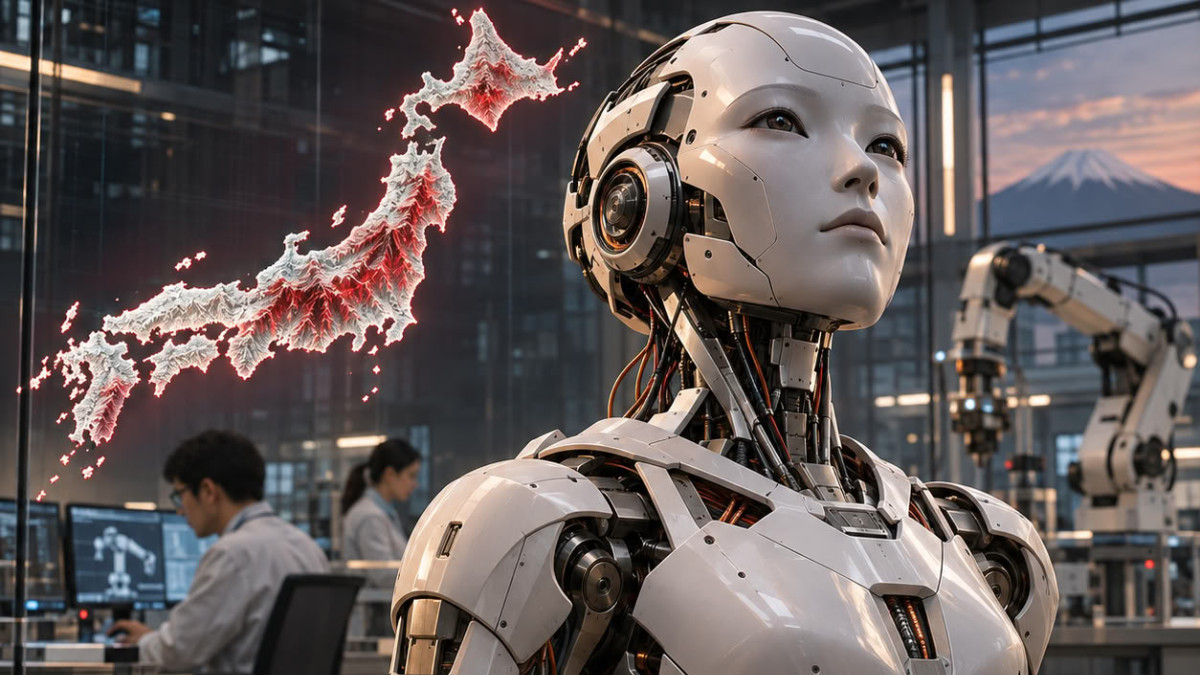

Japan is making robotics a pillar of its economic strategy, in response to its aging population and frequent natural disasters. According to an analysis published in a series on national robotics roadmaps by the IEEE Robotics and Automation Society (RAS), the country is betting on intelligent machines to support its economy in the coming years.
Japan is exposed to numerous natural disasters due to its geographical location, geologically active ground, and terrain. Robots are expected to speed up rescue operations and post-disaster searches, while limiting the exposure of workers and volunteers to danger. The Fukushima disaster in 2011 is cited as a reminder of these challenges.
Aging is a second challenge. Japan is the world’s oldest country: it has been considered a “super-aging” society since 2007, with nearly one-third of its citizens aged 65 or over. According to government roadmaps, the use of robotics is deemed essential to avoid a GDP collapse linked to labor shortages, particularly in healthcare, elderly care, and manual work. Unlike other countries that have chosen to reform their immigration policies, Japan maintains historically strict immigration rules.
A powerful, yet challenged, robotics industry
Japan claims the title of the world’s leading manufacturer and exporter of industrial robots for half a century. According to the International Federation of Robotics (IFR), 45% of the global supply came from Japan in 2022, with an export rate nearing 80%, to countries like EU members, the United States, and China. The document notes, however, that economic decline and competition from foreign manufacturing make it difficult to maintain this leadership in the global value chain.
To address these challenges, the government has defined Society 5.0, a project for smart cities based on technology. The framework is set by the Fundamental Plan for Science and Technology, updated every five years, with the 2026 version marking the transition to the 7th plan. In 2020, Parliament passed the so-called “Super City” law, which allows for the creation of regulatory sandbox zones, currently in Osaka and Tsukuba, where certain laws can be bypassed to test the integration of AI-driven robots in public spaces. Since September 2025, automaker Toyota has been operating its own test city, Woven City.
Japan also funds high-risk, high-impact research programs called Moonshot, with timelines spanning thirty years. Two of its current ten goals directly concern robotics. The 3rd goal, dedicated to the co-evolution of robots and AI, includes targets such as 90% of citizens feeling comfortable with robots by 2030, robots working in remote and dangerous places by 2050, and robots innovating autonomously by 2050.
In December 2025, this same goal was updated to prioritize the development of autonomous general-purpose humanoid robots capable of adapting to environments designed for humans. Japan had been a pioneer in this field with Asimo, developed by Honda in 2000. At the time, these machines remained very costly and poorly suited for real-world use, according to the document, but progress in low-cost actuators, additive manufacturing, and general-purpose AI has since removed some of these obstacles. While China and the United States are engaged in a race for humanoids, Japan is seeking to catch up.
In this context, the Ministry of Economy, Trade and Industry (METI) decided, in the same month as the Moonshot program update, to quadruple its previous AI investments to reach $8 billion, which would place the country third in AI spending, behind China and the United States. Approximately $2.5 billion is specifically earmarked for physical AI, i.e., robots. In March 2026, the Integrated Innovation Strategy was updated with the project to create R&D hubs in 16 sectors, to train AI-equipped robots and attract local and foreign talent.
A strategic partnership with the United States
Japan and the United States have been allies and trading partners for much of the past century. Both the Moonshot program and the 2022 National Security Strategy emphasize the importance of this cooperation. The United States is a global leader in AI but, according to the source, lacks a public strategy dedicated to robotic hardware, which could foster a complementary relationship with Japan’s industrial ecosystem.
The two countries have also initiated collaboration for deep-sea rare earth extraction off Japan’s coast, using robotic systems. The first successful extraction test, involving autonomous underwater vehicles, was conducted in February 2026. Finally, in a context of geopolitical tensions, Japan has made dual-use technologies a priority in its revised 7th Fundamental Plan, with research on unmanned vehicles and drones, a choice the United States supports according to the document.
