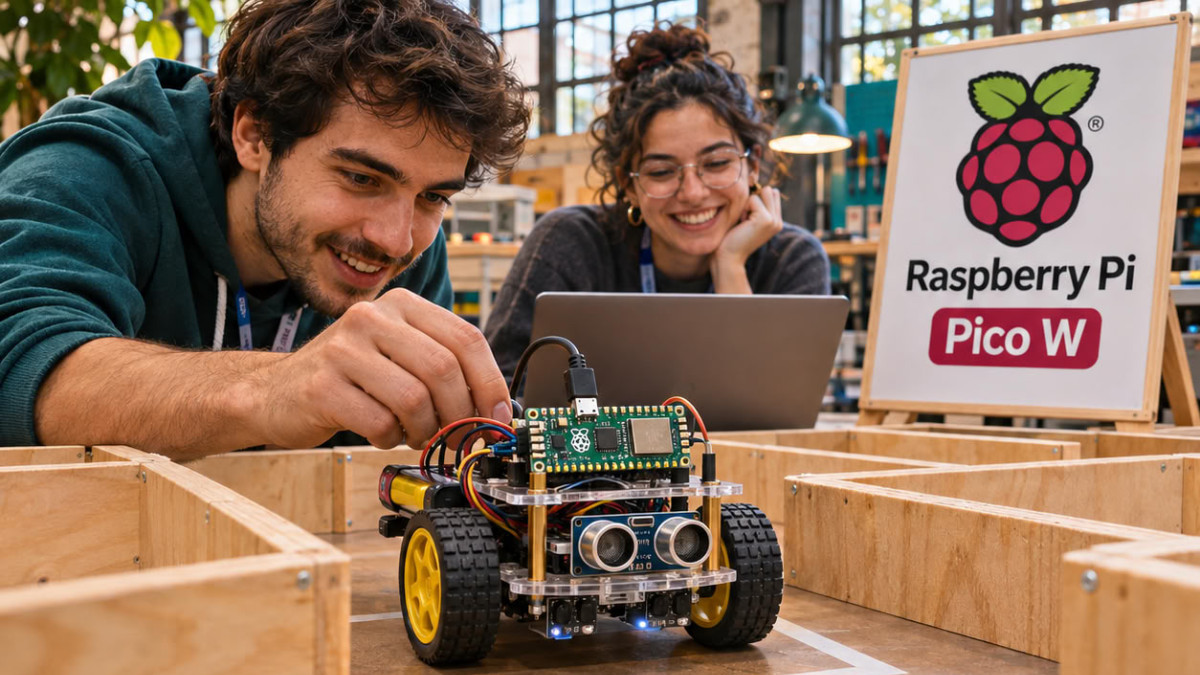

From August 25 to 27, members of the UK RAS STEPS network gathered at the University of York’s Institute for Safe Autonomy for a three-day hackathon dedicated to autonomous robotics. Participants were tasked with designing, building, and programming robots capable of navigating a series of mazes of increasing complexity.
Working in teams, participants used a custom robotic platform based on a Raspberry Pi Pico W board, a small microcontroller capable of driving electronic components. Each team designed a laser-cut chassis, integrated motors and sensors, and then developed its control software in MicroPython, a version of the Python language adapted for microcontrollers.
Sensors and Workshops Available
Teams had access to ultrasonic sensors, infrared sensors, and time-of-flight sensors, which measure distance to an obstacle by calculating the time it takes for a light signal to return. They also had access to laser cutting and 3D printing facilities.
The final challenge was judged on several criteria: maze performance, collision avoidance, robot design, code quality, wireless control, and any innovative features developed by the teams.
Tours, Presentations, and Demonstrations
The program also included a tour of the Institute for Safe Autonomy, collaborative development sessions, final presentations, and robot demonstrations. Beyond the technical challenge, the event served to test an activity that could, in the future, become a continuing professional development course for those new to robotics, or an outreach program for children and students.
The organizers thanked Rob Woolley, the University of York team, and all the participants who contributed to the event.
