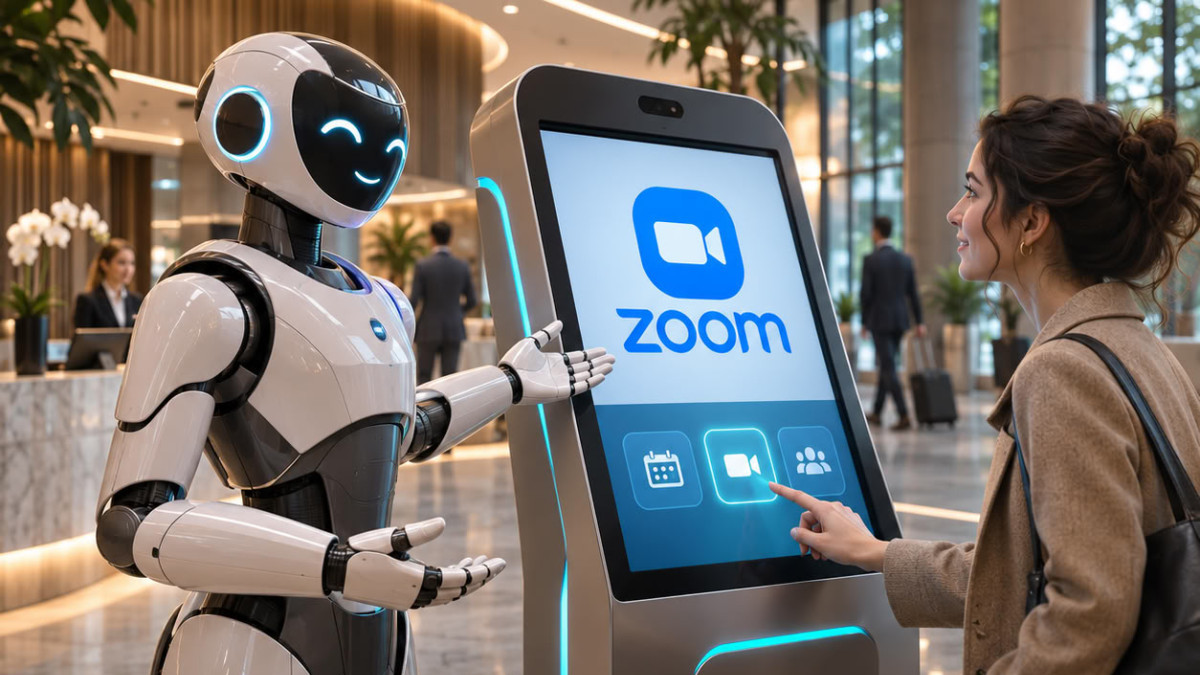

Zoom presented on November 4, at its London offices during Zoomtopia, several evolutions of its platform centered around AI agents. Among them is a virtual agent deployable on a physical kiosk, capable of informing visitors and executing tasks based on company data.
- Zoom étend ses agents IA vers les interactions dans le monde physique.
- L’agent virtuel Kiosk accueille les visiteurs sur bornes tactiles ou audio et exécute des tâches.
- L’architecte agentique crée un agent à partir d’une simple instruction en langage naturel.
- Performance Suite et CX Insights évaluent la qualité des agents et expliquent leurs décisions.
The publisher is thus expanding its scope, from videoconferencing to agents capable of performing operations. During this event, Leo Boulton, Head of Product, Solutions and Industry Marketing, presented an approach based on three steps: conversation, connecting information, and, crucially, task execution.
A virtual agent deployable with Kiosk
The agent can operate across different channels, from phone to chat integrated into a website, or on an interactive kiosk called Kiosk. Installed in a reception hall, store, or service center, it allows visitors to interact with a digital assistant via a touch screen or an interface equipped with an audio system, without necessarily requiring an employee.
During a demonstration led by Ben Neo, Head of GX EMEA at Zoom, and Leo Boulton, the publisher detailed the agent’s configuration. It relies on three components: instructions defining its role, scope, and tone; a knowledge base feeding its responses; and skills enabling it to execute actions. Content can come from existing repositories, internal documentation, or websites. Zoom states it can synchronize them, while specifying that the quality and updating of this data remain the customer’s responsibility.
The difference with a classic chatbot lies in execution. Faced with a hardware issue, the agent can identify the incident, guide the user through diagnosis, then trigger a return request or create a ticket in the CRM, the customer relationship management tool. A human in the loop, meaning human validation, can be integrated into the process. Interactions occur in natural language, spoken or written.
An agentic architect to simplify configuration
To accelerate deployment, Zoom offers an agentic architect that builds an agent from a simple natural language instruction. An administrator can thus request the creation of an IT support agent tasked with handling incidents and hardware returns, and the tool generates the corresponding instructions and skills.
The agent is first created in draft mode, then published after verification and testing. Teams can modify the produced elements, so human validation occurs before going live, even if certain tasks can later be automated. The same agent can be accessible from a website or by phone, with Kiosk constituting “an additional interface, not a distinct agentic product”.
Zoom has also enhanced the management of these agents with Performance Suite, designed to assess their processing quality, and CX Insights, which aggregates signals from interactions with virtual and human agents. The tool is meant to explain why an agent made a decision or adopted a given behavior, and to identify improvements to be made, helping contact center managers understand the root causes of an issue.
On the Zoom Workplace side, the publisher is working on a unified context layer, fed by meetings, in-person conversations, and professional exchanges, to help agents better understand their environment. Zoom also mentioned the arrival in December of enhanced note-taking features for meetings, including when the user is not directly attending.
The simplicity of configuration, highlighted during the London demonstration, is one of the levers for this adoption. The “Virtual Agent In-Person” variant, dedicated to interactions on physical kiosks, is expected for January 2027.
