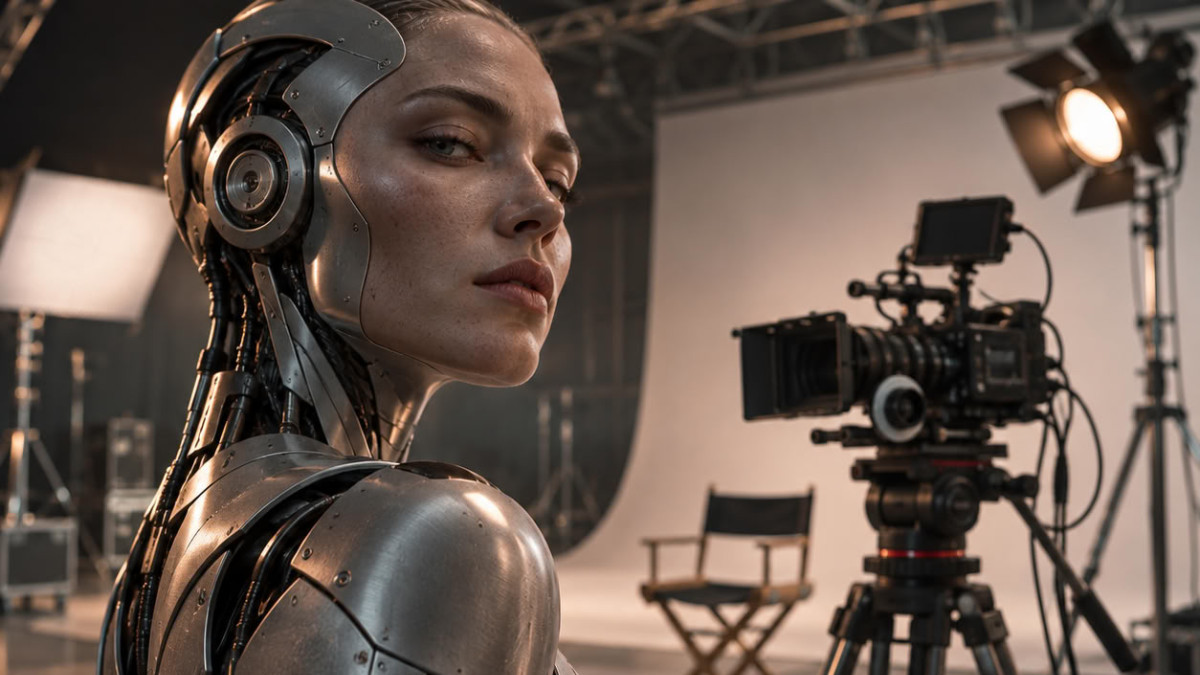

Artificial intelligence is making its way into major brands’ advertising campaigns, where a model, a landscape, or a voice can now be computer-generated. For advertisers, the promise is to produce faster and spend less. The question remains: what happens to actors, photographers, and film crews when ads are made differently?
- AI now generates models, landscapes, and voices for brand ads, cutting time and cost.
- Versus made an ad in two weeks instead of two months, at a fraction of a shoot’s cost.
- French ads mentioning AI nearly doubled in ten months compared to all of 2024.
- Public scrutiny is growing, and BETC still produces a third of its ads without AI.
A vintage red car crosses the capital, a bag on its roof. On the surface, it looks like a classic ad for a clothing brand. Yet, neither the dog, the car, nor even the actress exists: everything was generated on a computer from a text prompt given to artificial intelligence, written in English, the language it understands best.
This work is done through successive back-and-forths. “The level of precision ranges from what we see in the newspaper at the start, to the focal length used precisely to get a very specific blur in the foreground where the sharpness is placed,” explains Julien Rézette, Creative Director at Versus. Thousands of back-and-forths between the computer and the team are needed to produce a film in record time.
Reduced Timelines and Costs
“If AI hadn’t been used for this film, it could have taken two months, and here, we did it in two weeks,” emphasizes the creative director. This ad was billed at a few tens of thousands of euros, whereas it would have cost ten times more with a shoot.
The agency has already completed several dozen projects entirely created by AI, aired on television or on social networks. According to Sébastien de Milleville, CEO of Versus, the potential is infinite. “The technological leap between what we could work on a year ago and today is disproportionate. It’s probably the equivalent of 10 years in traditional production. And week by week, we see a quality of rendering and execution that is multiplied tenfold,” he asserts.
The industry is being shaken up. In the first 10 months of the year in France, 757 ads mention the use of AI, nearly twice as many as in all of 2024. Retail chains as well as children’s storytellers are using it.
An Increasingly Watchful Public Eye
In the corridors of the Paris metro, posters leave passersby skeptical. “First, the colors, you can see, everything that’s a bit blurred, it’s not super sharp. And then, of course, the person…” observes one user. Another adds: “It erases all flaws. We are perfect.” Some creations prove unconvincing, even botched, like when you can see two sleeves on a man’s shirt. Every ad is now scrutinized.
A film made for a luxury house, the Christian Dior ad, recently sparked debate. Internet users accused it of hiding the use of AI. The director claims to have drawn the work entirely and only automated certain movements.
Despite these controversies, agencies continue to adopt these tools. BETC, one of the largest advertising agencies in France, has been using it for two years. For a Bouygues Telecom ad, whose cost is estimated between 400,000 and 500,000 euros according to the report’s information, only the characters filmed face-on were shot for real, the rest being generated by AI, specifies Arthur Lemaitre, Creative Technical Supervisor at BETC. The client stands by this choice: “Digital advertising, especially on social networks, imposes a creation pace that humans struggle to keep up with alone.”
In this agency, however, shoots are not abandoned, particularly at the request of some luxury clients. “There’s an aspect of ethics or authenticity. You want to sell something today that is 100% authentic, if you do it in AI, the message will be a bit muddled,” points out Xavier Blairon, Director of Innovation at BETC. One third of the agency’s ads are still produced without any touch of artificial intelligence.
