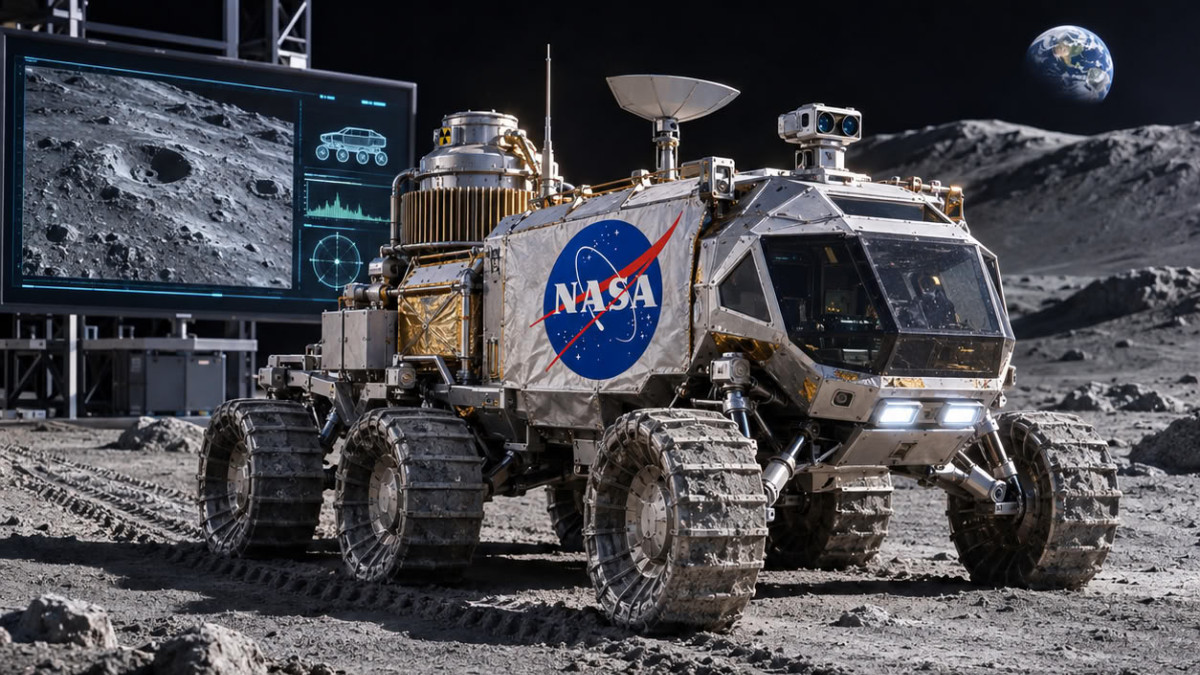

NASA plans to send a nuclear-powered rover, named PROMISE for Polar Rover for Observation, Mapping, and In-Situ Exploration, to the Moon’s South Pole. According to the source, this mission is intended to be a foundational step for the Moon Base Program.
A rover built from existing hardware
The rover will be built largely from existing hardware, including test bench components and spare parts intended for flight. These elements were developed for NASA’s ongoing Mars missions, Curiosity and Perseverance. Using this proven equipment helps limit the development of entirely new parts.
In another area, Boston Dynamics replaced the feet of its Atlas humanoid robot to see how it behaved when a learned controller made it move on wheels. According to the company, this configuration allowed it to heavily stress its actuators, as well as the models that describe them.
Automated assembly in orbit
The NOM4D (Novel Orbital and Moon Manufacturing, Materials and Mass-efficient Design) program, led by DARPA, has achieved what the source presents as the first demonstration of automated assembly in space. A payload from the California Institute of Technology (Caltech), placed in orbit, built a truss structure from individual components.
A gantry robot, capable of moving along three linear axes, connected composite elements using custom-designed joints, while deploying a thin reflective mesh. This experiment serves as a proof of concept for future space antennas.
Warehouse drones and multi-robot planning
The company Corvus Robotics presents the use of its Corvus One drones in the ASICS America distribution center in Byhalia, Mississippi. There, these devices count boxes and read every UPC code in both the reserve area and the single-item area, without any localization infrastructure in the building. No stickers, beacons, or markers are required.
For managing robot fleets in factories and warehouses, the Toyota Research Institute (TRI) has developed a custom solver. The problem, which can involve billions of calculations according to the source, cannot be solved by brute force, even with a supercomputer, which could take years to find answers. Andrew Best, a scientist at TRI, explains the institute’s approach to this multi-agent optimal planning problem in a one-minute video.
Finally, the AI in Motion podcast studio is launching its second season and meeting with American experts in physical AI. The featured episode takes place in Austin, where the team interviews Jeff Cardenas, co-founder of Apptronik, a company that designs humanoid robots with shapes close to those of humans.
