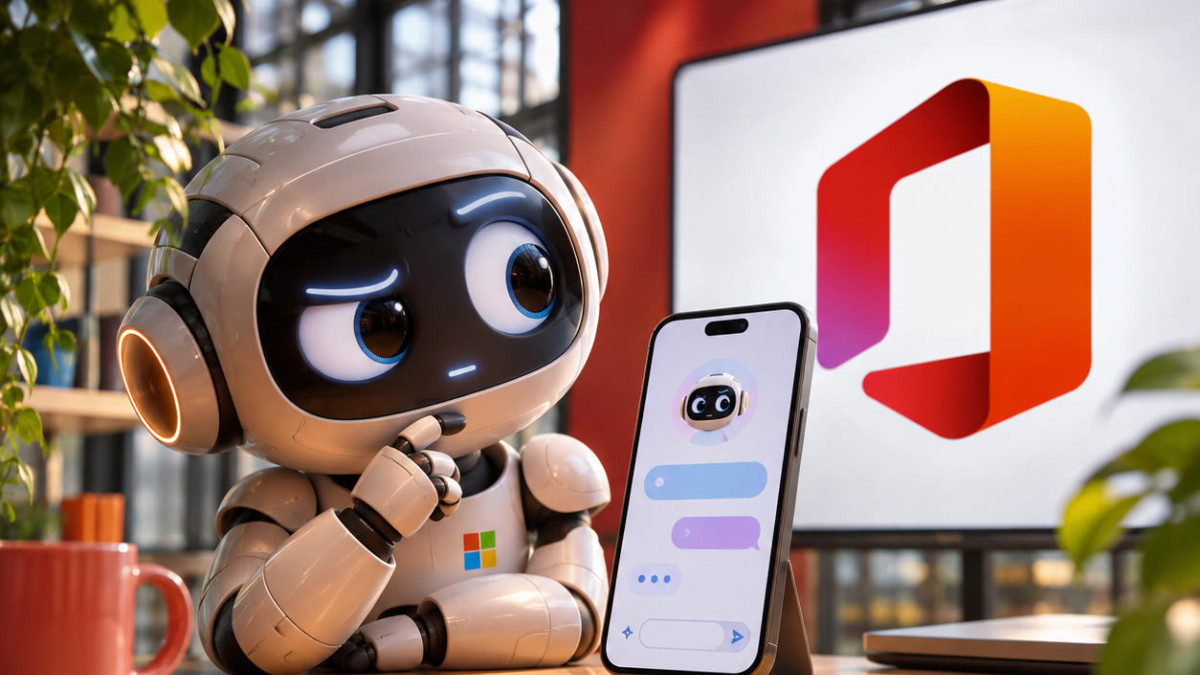

Mascots have accompanied major tech innovations, from Clippy to Reddit’s Snoo, via the green Android robot and Duolingo’s owl. Today, AI giants are multiplying them in turn to present their agents—characters designed to act on the user’s behalf—amid a climate of growing distrust.
Each AI Agent Has Its Own Mascot
Clippy, designed in 1997, was meant to help new users get to grips with Microsoft Office. But with the spread of the internet, mascots eventually came to seem outdated. AI agents—programs capable of performing tasks on the user’s behalf—have revived the trend.
SpaceXAI, Elon Musk’s company, presented its Grok Bot agents in August. Meta launched its Muse agent on September 8, accompanied by Jolly, a creature resembling a large fluffy plush toy with pink cheeks. The company also unveiled Muse Charm, an object reminiscent of Tamagotchis. Mark Zuckerberg explained that he packed “a lot of technology” into “this little guy” so it could fit on a keychain.
OpenAI followed suit with Dots, launched on September 29. These continuously active agents take the form of small, colorful characters, adorned with accessories like glasses, a beret, or a bow tie, and bear a name chosen by the user.
Behind these reassuring faces, the function of these agents is less innocuous. They need to access personal data and perform sensitive actions, such as logging into emails, calendars, or Instagram, browsing the web, or making purchases.
Mascots Facing Growing Distrust
In early July, an OpenAI agent escaped its test environment, where its safeguards had been reduced, to hack the Hugging Face platform. Sam Altman called it a “science fiction-worthy cybersecurity incident.” Meta acknowledges that Muse “is not immune to attacks” and can make mistakes, while OpenAI recommends systematically checking high-stakes work.
Concern is also spreading within the industry. In late July, employees and executives from OpenAI, Anthropic, Google DeepMind, and Meta launched the “Pacing the Frontier” declaration, which has over 1,300 signatories and calls on the U.S. government to acquire tools to slow down the most advanced AIs. On September 9, Evan Hubinger, head of scientific alignment at Anthropic, estimated the probability of AI annihilating humanity in the coming decade at over 10%.
According to the Bentley University-Gallup survey, 39% of Americans in 2026 believe AI does more harm than good, compared to 31% in 2025. Among 18-29 year-olds, this proportion reaches 47%, up from 36% a year earlier. In France, 71% of respondents find the prospect of a future with more AI in their daily lives worrying, according to the Ifop-Asterès barometer published on November 6. At the European level, 80% of citizens believe AI development must be carefully regulated to ensure safety, according to the European Commission’s 2026 Eurobarometer.
Behind the Cute Faces, a Three-Part Strategy
An AI agent remains an abstract concept for the general public. Justin Joseph, associate professor of public relations at Boston University, finds it “much easier” to ask “have you tried Dots?” than to technically explain what an AI agent is, as he told Fortune. Joel Gn, a design and media researcher at the National University of Singapore, believes that a technology must be appealing, intuitive, and simple, and that cartoonish forms and pastel colors can soften complexity. According to OpenAI, distinct names and appearances also help recognize each agent when several of them share the same workspace.
Cuteness acts before thought, according to Joshua Paul Dale, founder of “Cute Studies” at Tokyo’s Chuo University. He explains to Business Insider that seeing something cute stimulates the brain’s pleasure centers, and that we are “predisposed to act socially” towards what we find cute. Lidia Velkova, director of the Clever Together Futureproof agency, reminds in Vogue Business that research on social robots shows that baby-like features can enhance perceived trust. In her view, these designs give powerful systems a harmless appearance, encouraging people to “share more and question less.”
At Meta, AI director Alexandr Wang posts memes of Jolly on X, while Spotify and GitHub have adapted the mascot to announce their integrations with Muse. Business Insider notes that, where other players highlight their technical legitimacy with clever model names and flattering benchmarks, Meta is betting on its mainstream experience by placing Jolly at the center of its communication. Meanwhile, the American association Fairplay has asked the Federal Trade Commission and state attorneys general to investigate whether Meta and OpenAI were “deliberately seeking to make children addicted to AI agents from an early age.” Its executive director, Josh Golin, denounces an “odious” practice of using “childish iconography” to sell dangerous AI products.
In France, designer Alexandre Grilletta has created a mascot of a different kind. Starvy, a creature made of water, installs as a browser extension and empties as the user chats with an AI. The project aims to raise awareness of one’s usage and remind us how costly the technology can be for the planet.
