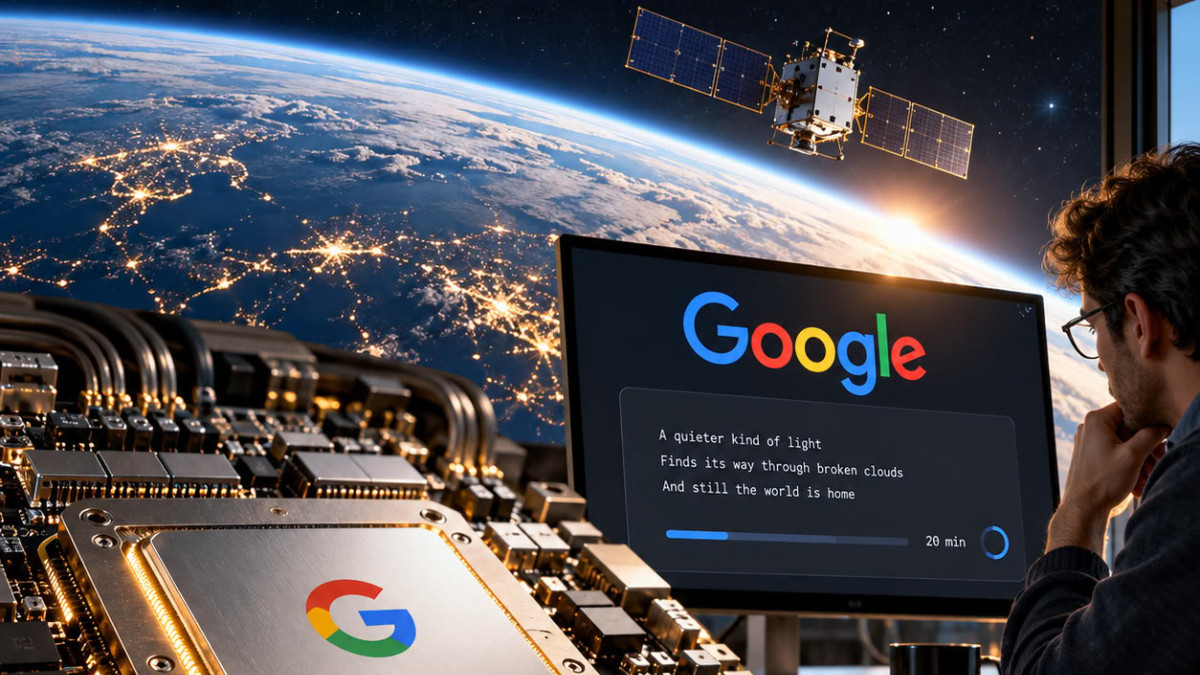

Google has reached a milestone with the prototype satellite for its Suncatcher project, launched on October 1, 2026 aboard a SpaceX Falcon 9 rocket. The first concrete application: an AI model produced a haiku from orbit, a technical feat that is also drawing criticism over its cost.
Developed in partnership with Planet Labs, the satellite is the size of a refrigerator and weighs approximately 500 kg according to an estimate. It carries four Tensor Processing Units (TPUs), ‘data center’ class chips identical to those used on the ground. According to reported details, the team sent a command from Earth, powered up the chip, executed the Gemma 4 model, and received a poem in return: ‘The blue Earth below / Data flows in graceful silence / Starlight feeds my heart.’ Sundar Pichai, CEO of Google, called the operation a ‘hello world’ milestone.
It is the mission’s cost that is sparking debate. Generating a short poem from Earth via a standard API would have cost a fraction of a cent, around $0.000012. In contrast, designing the satellite, integrating cutting-edge hardware, and paying for its launch by SpaceX, at an approximate rate of $7,000 per kilogram, brings the cost of this poem to several million dollars. For skeptics, this infrastructure mobilized for such a modest result illustrates the excesses of the speculative bubble around artificial intelligence.
Technically, the satellite can produce up to 1 kilowatt thanks to its solar panels, but the power consumption of a TPU limits its operation: it can only run for 15 to 20 minutes per session, before a shutdown phase intended to recharge its batteries and dissipate heat. In the vacuum of space, with no air to cool the components, Google uses heat pipes and fluid loops, which channel the heat to large radiators that reject the energy via thermal radiation.
A debate on large-scale feasibility
More broadly, NASA is among the critical voices. A former agency engineer, a specialist in space electronics, considers the idea of orbital data centers unrealistic. He points out that the solar panels of the International Space Station (ISS), with an area of about 2,500 m², produce just over 200 kW at maximum. Taking the NVIDIA H200 as a reference, which consumes about 0.7 kW per chip, and accounting for losses, a facility the size of the ISS could only power about 200 H200 GPUs, a figure to be compared with the tens of thousands of GPUs in modern data centers.
Cooling poses a comparable difficulty. The ISS’s thermal control system, which uses an ammonia circuit and large radiator panels, is limited to 16 kW of dissipation. To evacuate 200 kW, the expert estimates a system roughly 12.5 times larger would be needed, or nearly 531 m². He concludes: ‘I suppose it’s entirely possible if you really want to, but I think I’ve demonstrated above that it would be firstly extremely difficult to achieve, disproportionately expensive compared to terrestrial data centers, and would at best offer mediocre performance.’
Other obstacles are mentioned, notably radiation, which causes errors and failures in processors, and communication bandwidth. Satellites most often communicate with the ground via radio waves, with reliable bandwidth hardly exceeding about 1 Gb/s, whereas 100 Gb/s interconnects are considered minimal in a server rack on Earth.
Google must now test the resistance of its TPUs to heat and radiation, before launching two satellites linked together in 2027.
